As I seek in vain
Among the withered grasses
Any sign of spring
Above me the robins fly
And warble their twilight tunes
Link: withered grasses to withered grasses
As I seek in vain
Among the withered grasses
Any sign of spring
Above me the robins fly
And warble their twilight tunes
Link: withered grasses to withered grasses
Ki no Kotori
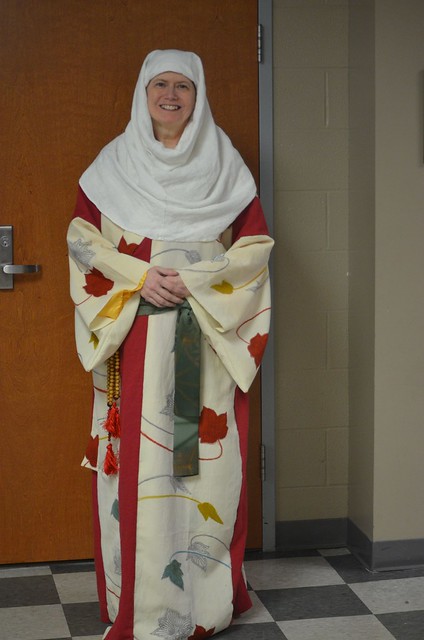
Photo by Master Edward Hauschild, 2019
Ki no Kotori 紀小鳥
aka Tace of Foxele, Maria Katerina von Adlerhof, Szabo Maria, Kári Gilsson, Ægileif in kyrra
Persona:
Ki no Kotori 紀小鳥 is a 10th century (Heian Era) Japanese courtier who has taken Buddhist vows(Heian Era). She is my primary Persona.
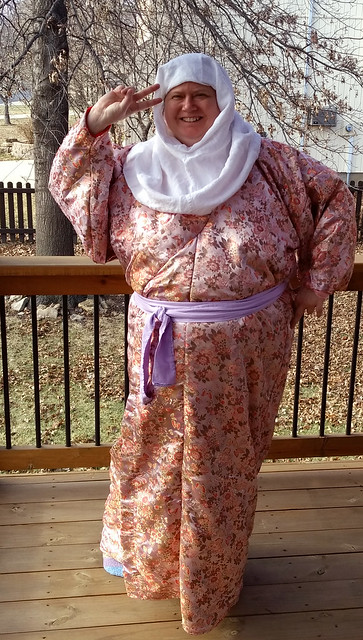
Momoyama-era garb, 2017. Photo by Lord Alfgeirr skytja
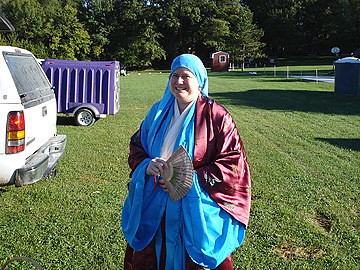
Kamakura-era garb, 2008. Photo by Lord Alfgeirr skytja.
Tace of Foxele is 12th century Englisc lady living in Norman-occupied England, at Foxele (modern Foxholes), in Yorkshire, 9 miles south of Scarborough.

11th century Englisc garb, 2004. Photo by Lord Alfgeirr skytja.
Maria Katerina von Adlerhof is a 16th century Austrian, in the service of the Habsburg Imperial Court in Vienna, Budapest, and Prague.
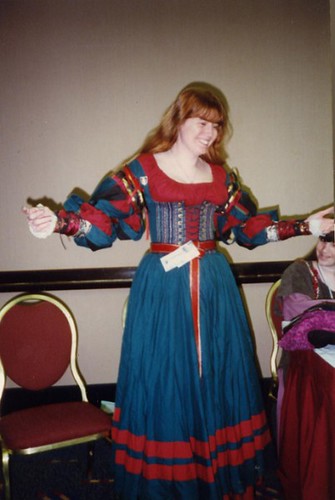
In Austrian Garb, 1996. Photo by Richard Gilson.
No photos yet for my other persona.
Link to Calontir Armorial – http://armorial.calontir.org/Pages/KiTorame.htm
History in the SCA:

Summer’s End Tournament, Barony of the Flame, Midrealm, 1993. I’m on the left with the red bandana.
Timeline:
* I started in the SCA in 1991, in the Barony of the Flame (Louisville, KY), Middle Kingdom
* Originally I was a heavy-weapons fighter. Injuries have sidelined me.
* AOA awarded by King Jafar and Queen Catherine, Midrealm 3/12/1994 for Service as Chronicler and at Demos.
* Became Squire to Sir David Dragonhawk, 9/24/1994
* Baronial award: Order of the Flamberge by Baroness Cordelia Tichy, Barony of the Flame, 1995, for Service at Demos.
* Moved to Calontir after I met my husband, Alfgeirr skytja. We lived in Coeur d’Ennui from 1998-2001.
* We moved to Dubuque in 2001 and started the Riverwatch contact group in mid-2002. It disbanded in 2006. After that, we were honorary members of the Shire of Deodar.
* Golden Swan awarded by King Valens and Queen Susannah for Calligraphy & Illumination 5/24/2003
* Torse awarded by King Joe-Angus and Queen Phaedra for service to the Riverwatch contact group 1/31/2004
* We moved to the Kansas City metro area in December 2012 and live in the Shire of Cum an Iolair.
* First event: Summer’s End Tournament, Barony of the Flame, Middle Kingdom, Sept. 1991.
*Granted entrance to the Order of the Calon Lily by King Xerxis II and Queen Belanna for Japanese Poetry and Research 9/15/2018
*Apprenticed to Ylva jarlkonna Jonsdottir 2/2/2019
* Link to Calontir OP is here.
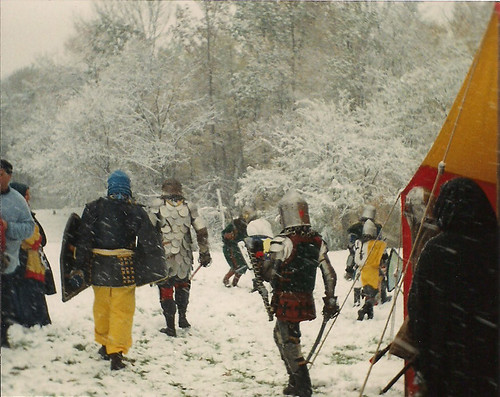
Fighting in the snow, Barony of Fenix, Midrealm, 1994. I’m in the Red and Green armor.
Groups and Affiliations:
* Current Group: Shire of Cum an Iolair, Calontir.
* Previous Groups: Shire of Deodar, Riverwatch contact group (Dubuque, IA), Barony of Coeur d’Ennui (all Calontir), Barony of the Flame (Midrealm)
* Guilds, Households, etc: Scribal guild, Bardic guild (Calontir), apprenticed to Ylva jarkkonna Jonsdottir 2019-present, squired to Sir David Dragonhawk (Midrealm) 1994-present, House Drachenstein (Midrealm) 1992-1994.
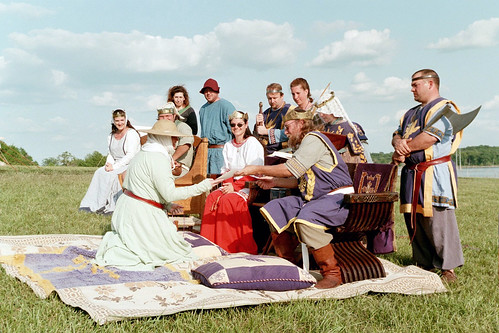
Being awarded the Golden Swan by Queen Susannah, Barony of Forgotten Sea, 2003. Photo by Verla Herschell.

Granted entrance to the Order of the Calon Lily by King Xerxis II and Queen Belanna, Queen’s Prize, Shire of Crystal Mynes, September, 2018. Photo by Edward Hauschild (Vilhelm Lich).
Offices:
* Local Offices: Past: Exchequer (Shire of Cum an Iolair) Talon Herald (Shire of Cum an Iolair) Chatelaine (Shire of Cum an Iolair) Deputy Seneschal, Chronicler (Barony of the Flame); Contact person, Herald, Knight’s Marshal, Exchequer (Riverwatch)
* Regional Offices: Assistant Signet (Southern Oaken Region, Midrealm, 1994), Lanner Herald Committee (Calontir 2016-2018)
* Kingdom Offices: None
* SCA-wide Offices: None
* Other service: Autocrat of five events: Summer’s End (1993), Collegium (1994), Christmas Tourney (1993, 1994) in Barony of the Flame, and Triskelion at Riverwatch (2004)
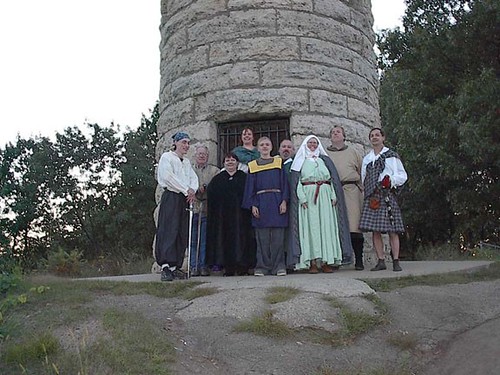
The Riverwatch Contact Group, Dubuque, Iowa, 2003. Photo by Lord Gaston le Mieux.
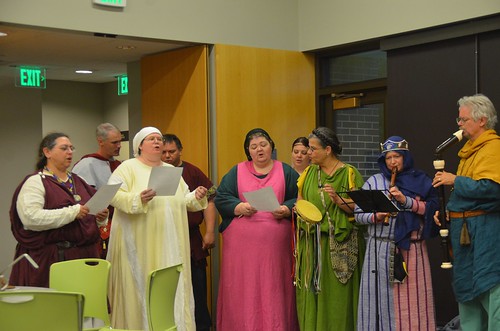
Members of the Shire of Cum an Iolair singing at Feast of Eagles, 2017. Photo by Verla Herschell
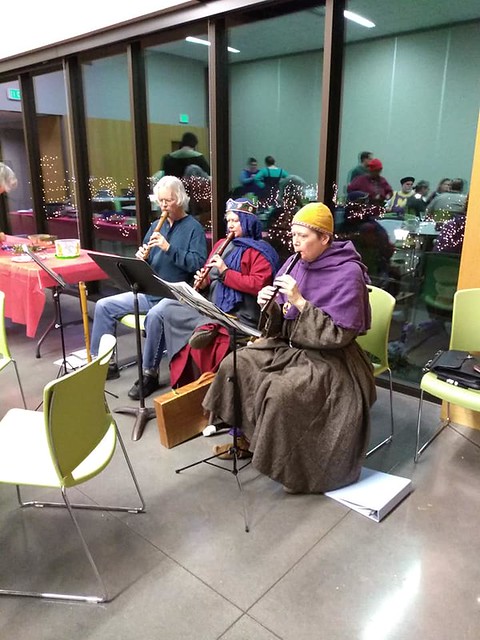
Roderick Noise Maker, HE Margaurite des Baux, and Ki no Kotori playing at the Cum an Iolair Christmas Party, 2018. Photo by Mistress Lilian Bowyer
Classes Taught:
* Basic Calligraphy: Carolingian, Insular Majuscule, Insular Minuscule, Half-Uncial, Shodo (many times)
* Scroll layout (many times)
* The Medieval Middle East (Collegium, Barony of the Flame, 1994)
* How to do Documentation (Riverwatch, 2002)
* T-Tunic Tutorial (Riverwatch, 2002, 2003)
* Let’s Renga! (Riverwatch, 2003)
* Let’s Tanka! (Riverwatch, 2004)
* Successful Event Planning (RUSH, Le Grande Tent, 2003; Flynthill 2005)
* Panel: Design Elements of 16th Century Japanese Clothing (Clothiers, 2017)
* Kosode Construction: Stitches, Tips, and Tricks (Clothiers, 2017)
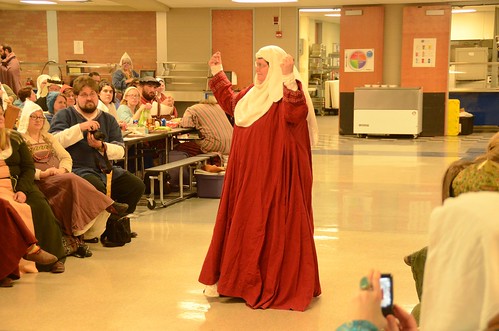
Displaying hand-made Englisc garb, Clothiers 2016. Photo by Verla Herschell.

Gratitude Scroll for the Busted Lift, a pub that let the Riverwatch SCA contact group meet in their building. 2002. It was later destroyed in a fire at the bar.
Other Information:
* My SCA blog is Foxeholly
* Some Scribal Examples can be found here.
* Documentation for past projects:
* Song: The Iowegia Song 2003
* Akikawa Nikki (A Poetic Diary) 2005
* Notes from Successful! Event Planning (2005)
* Wimples and Zukin 2008
* 20 Poems from the Shōyōshū (小葉集 Small Leaf Collection) 2015
* Song: Kestrel’s Lullabye 2015
* Poems from Daisougen Nikki 大草原日記 The Great Prairie Diary 2016
* An Examination of Zukin 2016
* Kosode Construction: Stitches, Tricks, and Tips 2017
* Song: The Falcon’s Cry 2017
* Composing and Designing a Japanese SCA Scroll 2017
* Kotori no Uta Hyakushu 小鳥の歌百首 (A Little Bird’s Song 100-Poem Linked Sequence) 2018
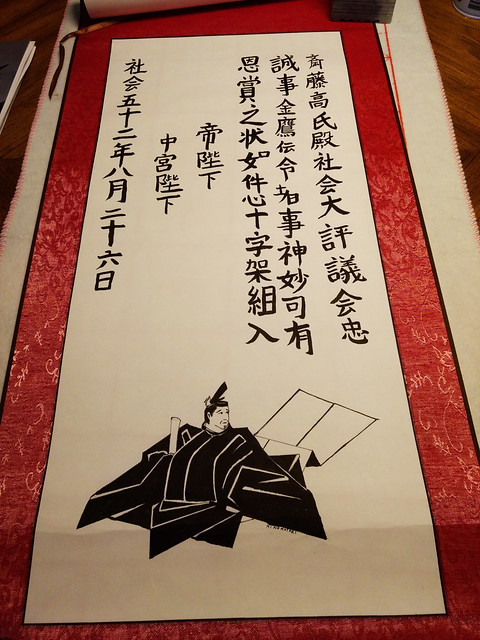
Calon Cross for Saito Takauji by Ki no Kotori (detail) 2017

There was a question on the SCA FB page regarding kyoji karuta (competitive matching-type card play). Since this was an area that I’d looked into a while back, here was my answer. Short form: karuta as an item appeared in Japan in the 16th century, but matching-type karuta games are an Edo-period development and do not fall within the pre-1600 guidelines set by the SCA
I did some research into this area a while back. The kai-awase (matching shells) is very much within the timeframe that the SCA covers. While karuta (which is a word based upon Portuguese for carta “card”) definitely came in during the 16th century, they were mostly used for European-style card playing and gambling–in fact, there seems to have been a book published in 1597 with rules for various gambling-type games. Karuta did start to be domestically made by the end of the 16th century but followed the design of European decks. The various matching games and uta-karuta developed in the Edo period, while kyogi karuta came about in the 19th century. So please keep in mind that, while amusing, kyoji karuta is not period. Here’s a good page (in Japanese) that explains the history of karuta very well.
Edo Karuta page: very good outline of the history of karuta. This is where I found the reference to the book written in 1597 called 博奕かるた諸勝負令停止, which from the kanji seems to be rules about gambling with karuta. Page is in Japanese.
Miike Karuta Museum’s page about karuta history. The museum is in Omuta, Fukuoka Prefecture, an area where a lot of the domestic Japanese karuta cards were made. It houses the most complete historical collection of Japanese karuta.
Wikipedia can be an iffy source, but in this case, the entry about karuta is thorough and has a lot of cites to follow.
(Image saved from an Ebay listing of uta-karuta cards. Yes, I have a set.)
Just putting this link here until I have more time to check into the subject. An Introduction to Kuzushiji.
Kuzushiji 崩し字 is that sosho-looking print script that was very popular in Edo-period texts. Very similar to sosho in several aspects, but lacks sosho’s elegance. Somewhere around here I have a book about the history of Japanese printing, and will look in that to see more.
I can make out some characters, due to my shodo studies, but can’t really say that I can “read” it.
Just posting this here to remind myself that I want to visit this place when I finally have a chance to go to Japan.
The Kampo Museum of Calligraphy, in Higashiomi, Shiga Prefecture. It’s about halfway between Nagoya and Kyoto. Here is the webpage: http://www.kampokan.com/english/
Walking in winter
The wood-fire scent hanging
In the crispy air
The withered grasses rustling
Footprints marring day-old snow
link: tending to the fire–wood-fire scent
Amusement beckons
Yet by the hearth I linger
Tending to the fire
What use the radiant sun
When icy winds come dancing?
link: hearth to hearth
Welcome the New Year
Like a beggar from the cold
Beaten and ashamed
Come, cast aside your sorrows
Warm yourself beside the hearth
link: cool wind soothe to warm yourself beside the hearth
The autumn palette
So calming to the senses
A balm to the soul
Weep, then, and let the cool wind
Soothe your heated countenance
link: leaves, green and gold to autumn palette
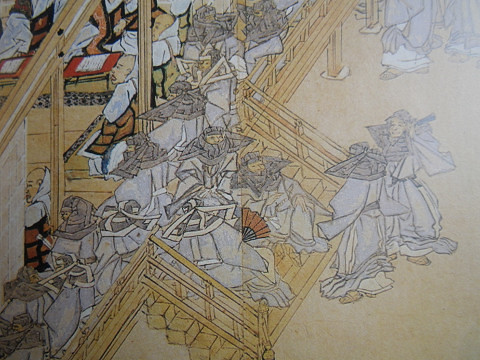
Detail from the Honen Shonin Eden (Life of the Monk Honen) emaki scroll (around 1307), showing monks wearing kato no kesa.
From a question on the Tousando Board about kato no kesa (someone had directed the questioner to my earlier post on the subject):
Yes, from what I have been able to figure out, kato no kesa are literally kesa worn on the head. The sōhei wore their kesa on their heads rather than on the torso as usual (perhaps for freedom of movement? or disguise?). So yes, as a shortcut you could just use a rectangular cloth tied around your head, but properly, those were kesa, which are sewn in a particular way. Most commonly, the “rice-paddy” pattern is used.
Gojokesa 五条袈裟 or Gojo no kesa 五条の袈裟 is also a term for this garment. From the dictionary definition, it was called that because of it was stitched together from five wide cloths (probably referring to the rice paddy design, which is usually done in five rows, but can be seven or nine, depending on the cloth used and the size of the wearer.
I found a cite for why they used discarded cloth:
“It is difficult to determine what is good and what is evil. Laymen say it is good to wear luxurious silks, embroidered garments, and brocades; and bad to
wear tattered and discarded rags. But in Buddhism it is the opposite: tattered robes are good and pure, richly embroidered garments are evil and soiled. The same applies to all other things as well.
The Madhyam-agama-sutra states, “Virtuous men! Suppose that someone acts purely but speaks and things impurely. If a wise man sees this and becomes angry, it is necessary for him to eliminate his anger. Suppose again that someone acts impurely
but speaks and thinks purely. If a wise man sees this and becomes angry, it is necessary for him to eliminate his anger. How can he do this? Virtuous men! He can do so by following in the footsteps of a solitary monk who picks up discarded cloth to make himself a pãmsula. Like the monk, if he finds the cloth soiled with excreta, urine, nasal mucus or anything else impure, he should pick it up with his left hand
and, stretching it out with his right hand, tear off the unsoiled and holeless parts.”
Yuho Yokoi. Zen Master Dogen (NY, Tokyo: Weatherhill, 1976)pp. 104-105.
As for wearing kesa on the head, it may also have been part of a religious ritual:
“Do-gen Zenji, at the age of twenty-five, was at Tien-tung-shan in China, doing zazen with many monks, when at the end of morning zazen he saw that a monk who sat
next to him held up the okesa with both hands, put it on his head, and with gassho
recited the verse of the okesa:
Great robe of liberation!
Virtuous field far beyond form and emptiness
Wearing the Tathagata’s teaching
We vow to save all beings.
After the monk chanted this verse three times he put on the okesa. Do-gen Zenji had
never seen this great practice before; he was deeply impressed and even shed tears
from a mingled feeling of joy and sorrow.
He talks about this in the last part of the “Kesakudoku,” saying that his robe’s collar was wet from the tears.
“When I was in Japan I read the Ãgama-sutras and found the verse of the kesa; I also found that before one puts on the kesa they should put it on their head. I had not known when and how it correctly was to be done as I had asked my master and friends
but none of them knew. I felt very sorrowful that such a long span of time had passed wastefully without knowing how to handle a kesa in spite of having been at
Hieizan for three years and at Kenninji for nine years. Now, I fortunately could
see and hear with my own eyes and ears the manner in which to wear the kesa
due to good deeds accumulated in previous existences. I was grateful and thankful.
If I had stayed in Japan, I would not have had a chance to see this great
scene. I took pity upon the people in my country because they could not see it”
Eihei Dogen Zenji, Shobogenzo – “Kesakudoku” (The
Merit of Kas´ãya); Shobogenzo -“Den-ne” (The transmission of
the Robe), trans. Yuho Yokoi with Daizen, Victoria.(Weatherhill, 1976).
The Dogen Zenji mentioned is the monk Dogen (1200-1253), founder of the Sōtō school of Zen Buddhism.
What I’m trying to research now is how the construction of the kesa may have changed over time. There are instructions online in English for making kesa (some quite extensive), but as they are concerned with modern religious Buddhist practice, they don’t really go into how the kesa might have evolved. We know that not all kesa were made from toilet rags–some extant pieces are quite fine, and may have been made with donated brocade. These are often seen being worn by wealthy lay-people. Both monks and lay-people (who had taken partial vows) were encouraged to wear kesa as a sign of devotion.
I dunno, just scratched the surface on what is a very rich tradition. It should go without saying–if you want to wear kato no kesa as part of your persona, please remember that it is still part of an ongoing religious tradition, and treat the garment with respect.
 Foxeholly