Step by painful step
How far is it, I wonder
There, as the crow flies?
Alas, earth-bound, I must walk
This winding, wandering road
Link: progression–pebble-strewn path to winding, wandering road
Step by painful step
How far is it, I wonder
There, as the crow flies?
Alas, earth-bound, I must walk
This winding, wandering road
Link: progression–pebble-strewn path to winding, wandering road
Seeking balance as
I tread the pebble-strewn path
On these wobbling knees
The Middle Way is steady
But not free from obstacles
Link: balance to balance

Woman writing letter at desk (c.1940s). Henry Clive (Australian, 1882-1960).
I have decided to do Nanowrimo again this year, as I do every year. Even though I haven’t ever managed to hit the word count, Nanowrimo has helped me generate some good bases for stories or write a good stack of poems. I just seem to write short stories better than novels, but novels are what people want. And yes, I’ll miss a week, but I’m going to attend a few of the write-ins in the area and maybe meet some new folks.
Anyway, I have an idea and a name “Ephemeroptera”. It’s a horror story. That’s about all I’ll say for now.
Yes, I still plan to do the Tanka Challenge. I want to finish my first batch of 100 linked poems. I’ve done 83 so far. The Tanka Challenge should finish the batch. Hyakushu (100 poem linked sequence) is way more challenging than stand-alone tanka, and honestly, it’s been hard to tap into my inner elegant courtier when surrounded by the ugliness of our current government. Every day brings a new horror. But I’ve been reading a biography of the poet Fujiwara no Sadaie (Teika), as well as a biography of the poet Shinkei, who lived about 150 years after Teika. I also have access to some poetic treatises written by both these poets, as well as one from a disciple of Shotetsu.
What interests me about both of these men is that they lived during turbulent times. Teika lived and wrote during the end of the Heian period and the beginning of the Kamakura period. Shinkei lost his home during the Onin Wars. Yet they produced some of the most stirring poetry of the Japanese middle ages. I want to read their poems and their thoughts and see how they did what they did, and whether it can be accomplished in English.
This project will take time, since there is a wealth of source material available (in English!), but it’s an avenue I would like to explore.
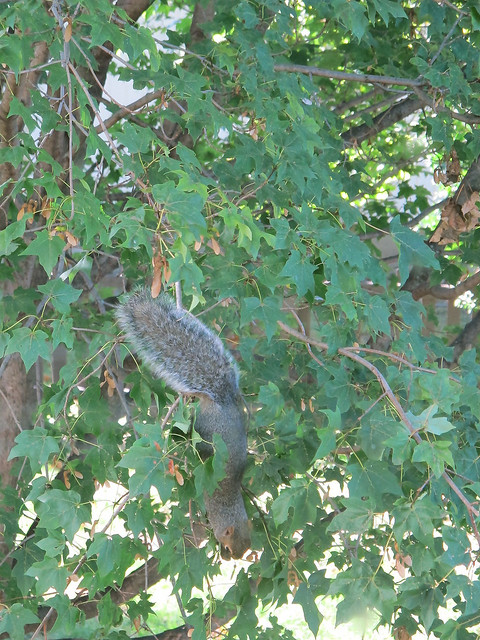
Cheeky squirrel swaying
Upside down in the branches
Of that maple tree
Will you teach me how you keep
Your balance whilst the wind blows?
Link: Progression from fall to balance
Rainy autumn day
Droplets on the still-green leaves
Hesitate, then fall
Nature seems to hold its breath
For the inevitable
Link: Hesitating to hesitate, then fall, so link AND progression
Soft sweet summer night
Distant laughter echoing
Life and love and light
A moth flits, hesitating,
Drawn to that forbidden flame
Link: progression from ink-dark night to life and love and light.
In the ink-black night
Chased by nightmares, I awake
Shivering with fear
Morpheus, must your whispers
Even haunt my waking hours?
Link: black with ink to ink-black night
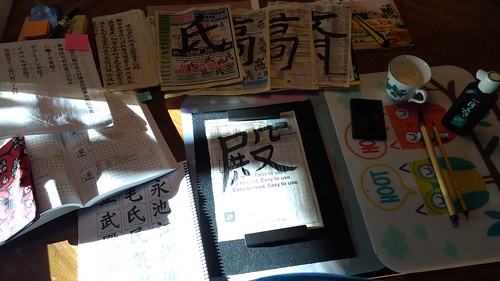
The harsh light of day
Burns away my illusions
And leaves me with truth
Yet my brush still black with ink
Hovers over the paper
Link: Fires burn to burns away my illusion
Mount Koya erupts
The monks of Mii-dera
Surging through the streets
From eve til dawn fires burn
Shut the garden gate and pray
Link: the light is there to fires burn
This poem was the result of a challenge: pretend for a moment that social media existed during your persona’s time period. What event would send them into a tweet storm, and what would that post look like? Bonus points awarded for posts under 140 characters.
Hey, that’s simple for tanka! Even more simple if written in Japanese. However, I got three lines in and my grammar failed me. Adjectival nouns are straight-forward (add な) but in Ancient Japanese, it would be なり, I think? Anyway, it didn’t scan. I need to study more. So this came out in English and not a stylish poem at all, but it fit the challenge.
The poem describes how the monks on Mount Koya, a holy place with several monasteries, used to occasionally get rowdy and riot through the streets of Kyoto, particularly towards the end of the Heian period. There were several monasteries involved, not all on Mount Koya. Mii-dera was just one of many.
The heavens shine down
Upon an uncaring world
Mired in darkness
The light is there if only
We would just lift up our eyes
link: progression: it’s full of stars to the heavens shine down
 Foxeholly