Cornificia Project

I signed up to do an outfit for a project that one of my fellow Calontiri, Cecilia, is doing: she is creating photographic portraits recreating the illuminations in Richard Tessard’s version of Boccaccio’s “The Lives of Famous Women”. You can see the pictures on this Pinterest page. My first two choices were already taken, but I settled on the portrait of Cornificia, who was a 1st century BC Roman poet. The dress is plain compared to some of the others, so I think I can manage it, plus with that pose and the cloak, it won’t matter that I’m so fat.

Boccaccio writes of her that “She was equal in glory to her brother Cornificius, who was a much renowned poet at that time. Not satisfied with excelling in such a splendid art, inspired by the sacred Muses, she rejected the distaff and turned her hands, skilled in the use of the quill, to writing Heliconian verses… With her genius and labor she rose above her sex, and with her splendid work she acquired a perpetual fame.” Her work is lost, but St. Jerome mentions her in his chronicles in 4th century AD, so her work was good enough that it was being read 400 years after her death, and by St. Jerome to boot, who was not an easy man to please.

Here is the picture she will be recreating:
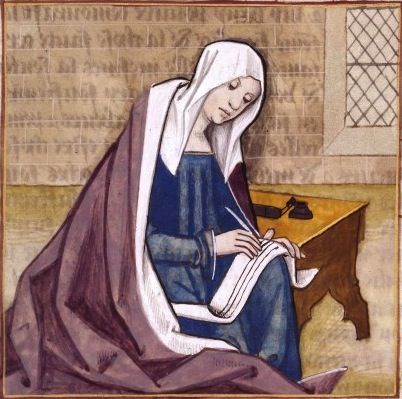
Cornificia

Although color substitutions are being allowed, I think I already have linen in both that blue and the light purple. The tight sleeves look like those of a Gothic fitted dress, but those gathers in front resemble a houppelande? But those tend to have big or hanging sleeves and women mostly wear those belted. This dress is NOT belted. It might be some kind of loose gown?

There’s a similar dress on the Blessed Virgin Mary in The Calvary Triptych by Hugo van der Goes (@1468). Sleeves are a bit different, but the shape of the dress looks similar.
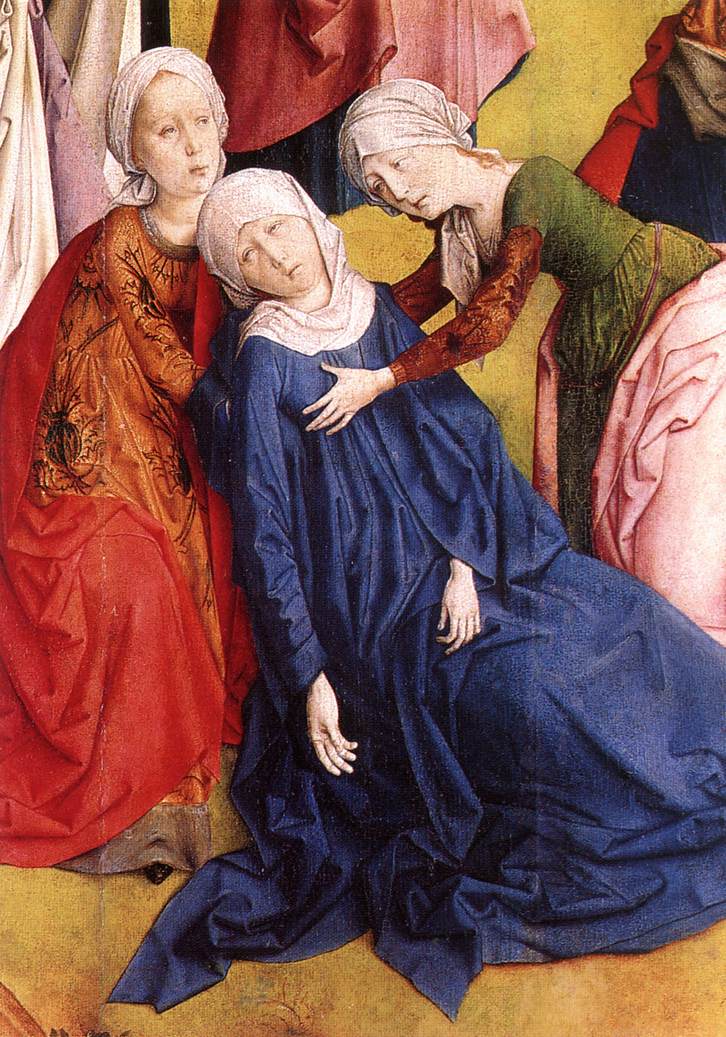
hugo_van_der_goes_1469

Here’s another example by van der Goes from the Monforte alterpiece. He puts the Virgin Mary in this same style of dress consistently.
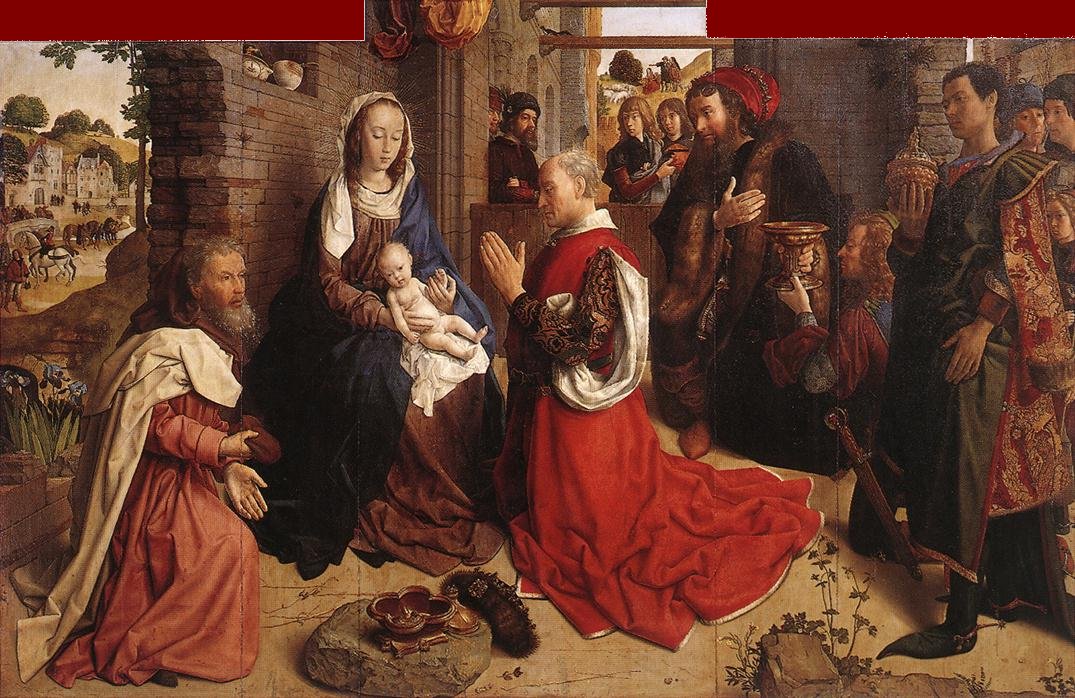
vandergoes_wijzen_monforte_grt

So anyway, have some research to do. I’m going to try to finish this outfit by December, 2017. I will be making the dress, underdress, veil, and shoes (unseen in picture).

小鳥の歌 23-26

Eternity waits
It is unkindly patient
And will not be rushed
But we who are mortal strain
To constrain every minute

A trap, a rope to
Tie me with, I will not lose
My freedom this way
Entice me with your smiles
Enfold me in your warm arms

Arm for a pillow
I gaze at your sleeping face
Noble in repose
Alas, I cannot stay long
The night passes in patches

Passing in patches
The night is stitched up roughly
Like a well-worn quilt
Falling apart at the seams
Barely holding together

Links: 23 “each breath an eternity” to “eternity waits”
24 “Constrain” to “a trap, a rope to tie me with”
25 “enfold me in your warm arms” to “arm for a pillow”
26 “Passing in patches” to “stitched up roughly”

小鳥の歌 22

Every night and all
Some cry, some pray, some seek peace
Within another’s arms
Autumn’s widening shadows
Each breath an eternity

Link: Okay, this one is a little obscure: The living and the dead to “every night and all”, which is part of the chorus of the Lyke Wake Dirge.

My favorite version of this ancient song is rather modern, by Andrew Bird and Matt Berniger of The National:

小鳥の歌 21

A storm-fallen tree
Leaves in disarray my heart
Broken asunder
A torrential deluge falls
Upon the living and the dead

Notes: Link Hurricane to fallen tree. The last line is a twist on the last line of “The Dead” by James Joyce: “His soul swooned slowly as he heard the snow falling faintly through the universe and faintly falling, like the descent of their last end, upon all the living and the dead.” That sentence has haunted me since I first read the story in high school.

Also note rare English kakekotoba (pivot word) in the 2nd line (my heart) that actually works like it might in Japanese, changing the meaning depending on whether you attach it to the words before or after.

Yes, I’m really upset about my dead tree.

小鳥の歌 20

Lonely, I wait here
Where none but God can find me
He isn’t looking
Like a garage-sale puzzle
Not all the pieces are there

2nd poem

Oh, I cannot breathe
The filthy air clouding my lungs
In these godless times
A hurricane of chaos
Envelops the innocent

Link: poem 1 godless month to where none but God can find me. Poem 2 godless month to these godless times.

I will probably use the 2nd poem in the final sequence, as the 1st one is too modern in feel. But I liked it enough to post it.

小鳥の歌 19

Where are the colors?
How late the summer lingers!
The leaves still verdant
A season out of season
A month when there are no gods

This one is rather hard to see: a mother, sighing, I bend down to start cleaning — to Where are the colors? It actually started as where are the CHILDREN, but the poem then turned into a comment about the leaves remaining green this far into October Kannazuki (神無月) short for kaminashizuki “the month when there are no gods”, commonly called the “godless month” in the Japanese calendar. The eight million or so native gods of Japan all travel to Izumo taisha (the Grand Izumo Shrine) in October, leaving the rest of the country “godless”.