Calontir Clothiers Symposium 2017

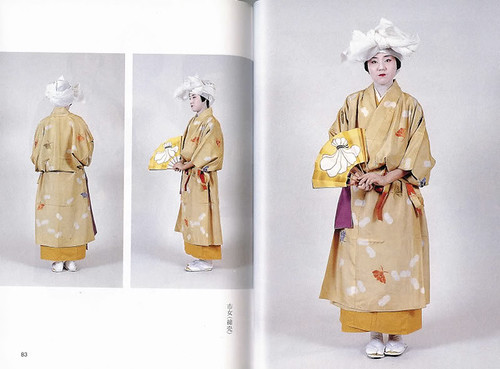
muromachi_kosode

Today was the Calontir Clothiers Symposium, which is held by my local Shire, Cum an Iolair. Since it is our local event, I spent much of the day working, mostly at my usual post at Gate. I did sit in on one class in the afternoon, but that was because I was helping with the next class and teaching a third class after that, so I needed to find out what this class covered so that I could adjust my materials accordingly.

Every year at Lilies War, there is a “Tailoring Tent” where volunteers sew like mad to finish a set of outfits for the King and Queen. The theme this year is Japanese, and so I of course am helping out.

The class I helped out with was a panel about 16th century decoration motifs. Since I was just sitting on the panel, I did not do a handout for this class, but I did try to steer conversation around information that I found about kosode history from this website here, which has an excellent overview of the kosode and its evolution. I brought a large number of books and magazines that I own so people could look through them and get ideas.

My own class was called “Kosode Construction: Stitches, Tips, and Tricks.” I was under the impression someone else was doing a class on kosode patterning, so the focus of my class was on the areas that gave me problems when I was first learning to sew kosode. Here is the handout I made. It just touches on the topics I covered, but I tried to include links to online tutorials or videos that might be helpful.

Truth be told, I’m always horribly nervous when teaching, but my students seemed to really enjoy the class and said they got a lot out of it. I was especially touched by one guy who caught up with me afterwards and thanked me, because he had been nervous about trying to sew his own Japanese garb, but now he thought it was something he could handle. That makes it all worth it.

Went out to dinner with some friends, which was fun, but missed the postrevel as I was absolutely exhausted. It was a fun day.

Front picture “Muromachi Kosode” was taken from the book “The History of Women’s Costume in Japan.” Japanese costume recreated in Kyoto during the 1930’s. (Scanned by Lumikettu of Flickr). I do own my own copy of this book as well.

小鳥の歌 47

01272017

In these twilight times
I cannot begrudge the birds
Their cheerful singing
My heart takes hope, my eyes lift
To the sky with new resolve

Another birthday poem. This one is not linked by words but by meaning–it is a progression from “door opening” to “new resolve”.

I was amused by the reaction to this poem on my Facebook. For me, I meant the “twilight times” to refer to the current political turmoil in the US. A childhood friend of mine mistook my meaning for me thinking about growing older. I was so pleased, as so many medieval Japanese poems tend to couch political meaning into terms that could be interpreted otherwise.

Pre-Edo Sashiko?

This is part of a thread on the SCA Japanese FB page. The original question was whether shibori or sashiko could be pre-Edo period. Shibori certainly was, although called by another name. I’ll do a separate post about that later, since shibori is an area I’m just starting to learn about.

However, I’ve been looking into sashiko. The problem documenting it is that it was a technique used by the poor, and the extant pre-1600 garments that exist are from the upper-class. What we do have is some examples of kesa (the surplice-like garment worn by Japanese Buddhist clergy), which were pieced. That technique existed. Most period paintings/drawings do not have a lot of detail on the poor. Some emaki have depictions of poor people, mainly in line drawings.

So with this lack of resources, you have to look into literature–for example, in a choka poem in the Man’yoshu by Yamanoue no Okura (660?-733?), a destitute man complains of wearing nothing but rags, “a sleeveless jacket not even stuffed with [cotton]” <–translation Steven Carter–I'd need to dig into the text to see the exact wording. While most poetry after Man'yoshu avoided the subject of poverty (until the 17th century poets revisited the subject), there are plenty of tales and writings that have some small bits of description. Padded garments require some supportive stitching, or else the padding eventually slips. Through literature, we can establish that garments were patched.

The decorative sashiko (blue on white) is almost certainly Edo-period, though. But using sashiko stitching as a means of insulation–that might be plausible.

Mistress Saionji no Hana (OL, West Kingdom) posted a link to a discussion on the Tousando Board from some years ago, where there was a discussion about an 8th century example of the kind of stitching used in sashiko. I happen to have a copy of the book mentioned, Jodai-Gire: 7th and 8th Century Textiles in Japan from the Shoso-In and Horyu-Ji by Kaneo Matsumoto and yes, there are a few examples of what looks like sashiko-like stitching. For mending purposes, however, not decorative.

小鳥の歌 45

0113

Now the door closes
Memories gathered, sorted,
And stored in our hearts
We raise our voices and sing
A little burying song

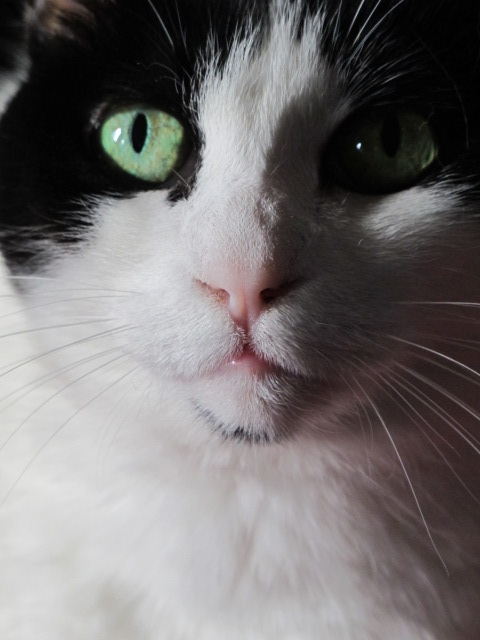
We got a sympathy card from our vet that included a copy of Nabiki’s paw prints. We both wept a little, but laughed also when we remembered how heavy she could be (how can such a small cat feel so heavy on those little paws?).

小鳥の歌 44

Nabiki
February 1st, 2000 – January 9th, 2017

Nabiki

From my arms she sprang
Across a bridge of rainbows
Into a kinder land
Rest in Peace, my little one.
You were the best cat ever.

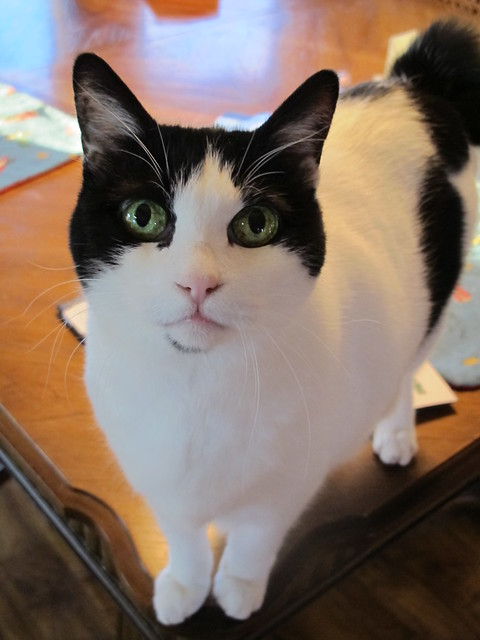
We had to put Nabiki to sleep on January 9th. She was just a few weeks shy of 17 years old. As I had feared, her thyroid disease was progressing, and the treatment options were getting past what we could afford. She had lost a whole pound since she was last at the vet 3 months ago, and she was a very small cat to begin with. She was so hungry, all the time. When she wasn’t sleeping, she was begging for food. And I would feed her, but she burned right through it. I just didn’t want her to suffer anymore.

Nabiki was the sweetest-natured cat that I have ever met. Feisty, too, when she needed to be–no cat was going to boss her! (Except that they did, but she made her displeasure known.) She was so cute and funny, and honestly, my favorite cat of all the pets I’ve had.

I will miss her so much.

This Old Thing

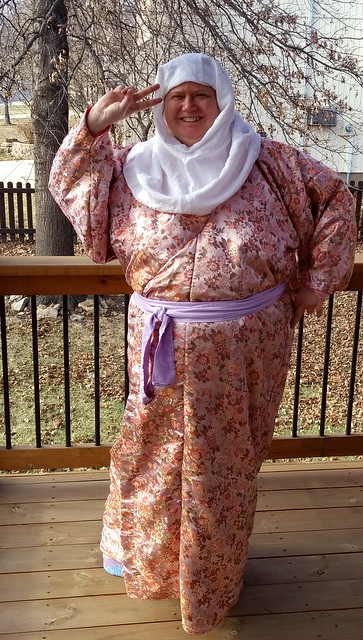
This was going to be a “Help, fashion emergency, should I wear this old thing or my standby Anglo-Norman garb that everyone has already seen this weekend?” but since the Calontir Coronation got pushed back a week due to the impending Ice-pocalypse, I should have time to finish something else, so I’m just posting these because I have so few pictures of myself in Japanese garb.

At my size, I feel a bit self-conscious wearing it. My body type is 100% Hungarian-American Good Peasant Stock–we’ll live during those famines!–and utterly lacks the narrow-shouldered, slim silhouette common to the Japanese. Which is why I like to make and wear garb of various cultures and not just Japanese. I do look better in European styles.

I’m wearing this as a kosode (“small-sleeved” kimono), but it was originally made as an uchikake (worn open over kosode) some 12 years ago. I’ve gain a lot of weight since then, so it doesn’t fit properly. It should be more baggy, actually, with very wide panels. There are some design things I would do differently now because I know better, but this wasn’t bad for an early work. While the Chinese brocade I’m wearing is modern, it’s not too far off from what might be worn–the Japanese DID import Chinese brocade. Besides, this was on sale and affordable.

I am wearing two kosode underneath–it’s cold here. They wore narrow obi (belts) during that time, just below the waistline, similar to how men wear obi now. This one has some interfacing to stiffen it up a bit, but time has softened it and I need to make a new one.

The wimple-like thing is called a zukin (I’ve written a few times about those–this one is a sode-zukin). My short and modern haircut just doesn’t go with medieval garb (of any country) at all, so I always wear some kind of head covering. Fortunately, it was common for upper-class women to take partial Buddhist vows, so you can wear zukin with fancier garments, although they are much more commonly used with lower-class or monastic garb.

01122017_moi_kosode_kawaii_large

Admin Note

I beg pardon for any new people who got hammered with posts this week. My previous blog was on Livejournal, but because it was set up as a community, it would not import directly into WordPress, so I was manually cut-and-pasting my old entries. I am now caught up and so the pace will slow down!

At some point, when I have time or insomnia, I’ll go back and make note of the dates of the original LJ posts. Right now, though, I’m going to play with the layout and appearance–what I originally set up was very bare-bones.

I have noticed some likes and follows. Thank you, and I will take a look at your blogs as well.

小鳥の歌 43

Smiling serenely
My hands stretch out to offer
Congratulations
Nameless, faceless, I step back
And return to the shadows

Link: serenity to smiling serenely

Two people I know (one online, one in person–although he moved out of kingdom some years ago) were invited to join the Order of the Laurel today. They have worked hard and I am very happy for them. As for myself, well…

I should note there was a tradition of poets expressing disappointment at being overlooked for advancement. I will do a post on that in the future.