Composing and Designing a Japanese SCA Scroll

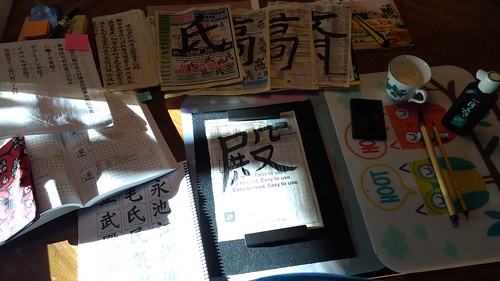
The Queen’s Prize Tournament for Calontir was this past weekend, and my entry was the process behind how I did the Calon Cross scroll for Saito Takauji. Here is a link to the documentation: Composing and Designing a Japanese SCA Scroll.

Award Scroll for Saito Takauji

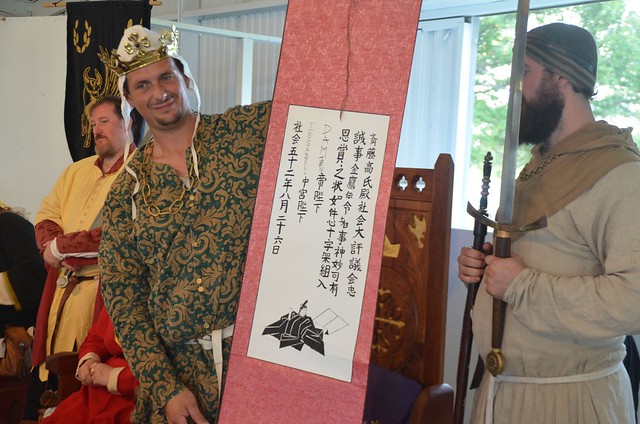
It was an exciting and emotional day. One of my friends, Giraude Benet, was asked to join the Order of the Laurel. Another friend, Ysabel de la Oya, won the Queen’s Prize, and a third friend was awarded the Golden Calon Swan (an AOA-level arts award) that was from another design of mine. I got very good feedback on my entry, and got to see several other fascinating entries as well.

Photo credit: Vilhelm Lich (Edward Hauschild)

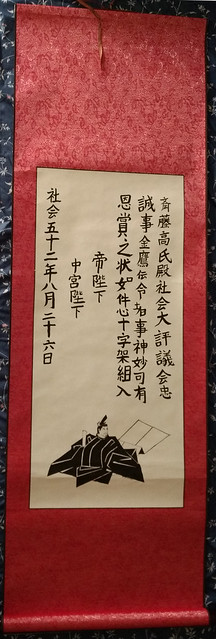
Scroll: Calon Cross for Saito Takauji

So now that it has been handed out, here are pictures of the scroll that I was working on. The Calon Cross is a Grant of Arms (GOA) level award in Calontir (they do pre-prints for AOA level awards) and is given out for service. Uji is a friend, so I was very happy to be given this assignment.

The text says: That the loyal civil acts of Saito Takauji, for the Society, the Grand Council, and as Gold Falcon Herald are excellent and will be rewarded, is stated thus. We raise him to the Order of the Calon Cross.
Damien, King
Issabel, Queen
Year of the Society 52 year, 8 month, 26 day

Saito Takauji dono ha Shakai ya Dai hyougi-kai no chuusei koto to kintaka denreisha koto ga shinmyou, onjou no jou koto kuden.
Shin juujika gumi ni irareru.

Damien mikado heika
Issabel chuugu heika

Shakai gojuu ni nen hachigatsu nijuu roku nichi
斎藤高氏殿社会大評議会忠誠事金鷹伝令者事神妙可有恩賞之状如件
心十字架組入
ダアミエン帝陛下
イサベル中宮陛下
社会五十二年八月二十六日

The model I used was from the Documents of Iriki, 96-2, #83-C, from Kenmu 3, 8th month, 17th day (September 22, 1336), given to one Shibuya Shigekatsu by Ashikaga Takauji, the first Shogun of the Ashikaga line. I took some set phrases from it, and added what phrases were needed for this award. I had Foro Pallavincino (Baron Christoforo from Northshield, who has a degree in Japanese and lived there for a few years), look over my Japanese text and make suggestions, which I then modified a bit. It is all in kanji–the hiragana that would be used in particles were not usually written down in these documents. Ink on washi paper, pre-mounted scroll. The kanji is written in kaisho script (the original was in gyousho script, but I was going for clarity here). The painting is based on a portrait of the poet Ki no Tomonori (who bears an amazing resemblance to Uji!), done in the Nise-e style.
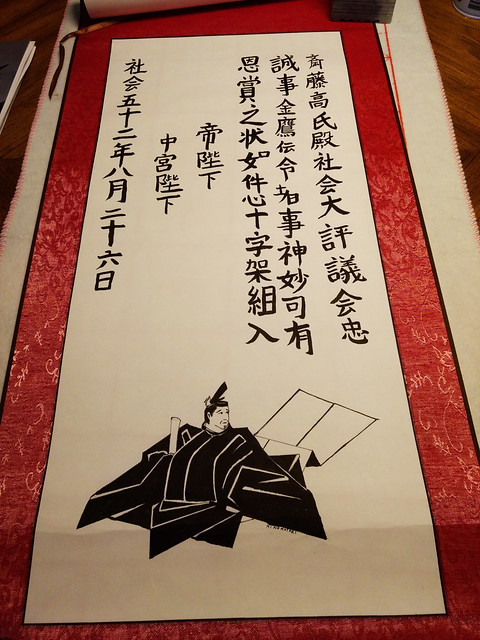
takauji_finished_scroll_detail

takauji_full_scroll

I definitely learned a lot while doing this scroll. There are some things (mainly in the brushwork) that I feel could be better, but the recipient was very happy, and that is what matters. I’m looking forward to tackling another design in the future.
小鳥の歌 78

Mount Koya erupts
The monks of Mii-dera
Surging through the streets
From eve til dawn fires burn
Shut the garden gate and pray

Link: the light is there to fires burn

This poem was the result of a challenge: pretend for a moment that social media existed during your persona’s time period. What event would send them into a tweet storm, and what would that post look like? Bonus points awarded for posts under 140 characters.

Hey, that’s simple for tanka! Even more simple if written in Japanese. However, I got three lines in and my grammar failed me. Adjectival nouns are straight-forward (add な) but in Ancient Japanese, it would be なり, I think? Anyway, it didn’t scan. I need to study more. So this came out in English and not a stylish poem at all, but it fit the challenge.

The poem describes how the monks on Mount Koya, a holy place with several monasteries, used to occasionally get rowdy and riot through the streets of Kyoto, particularly towards the end of the Heian period. There were several monasteries involved, not all on Mount Koya. Mii-dera was just one of many.

小鳥の歌 76

A little bird sings
In the surrounding darkness
Only crickets chirp
The fireflies dance and die
My God it’s full of stars

link: glow of fireflies in the twilight to fireflies dance and die.

“My God it’s full of stars” is from Arthur C. Clarke’s Novelization of 2001: A Space Odyssey. Although widely believed to have been said in the movie, it actually wasn’t. I refer here to things I thought I heard, but were not actually said. That seems to happen to me a lot nowadays. I don’t like it.

The poem can be read forwards or backwards.

The Falcon’s Cry

I wrote a new song, that I hope to debut at Feast of Eagles (if the Shire allows it). The tune is Palestinalied (12th century). Here is an example of the tune and original words.

The Falcon’s Cry
by Ki no Kotori

Calontiri, gather ‘round me
Tuck your tender tears away,
Battle calls, we must be ready
To march in and join the fray
Turn your eyes unto the sky
Listen for the falcon’s cry
Thus we live and thus we die

Fierce Huscarls, sharpen your axes
Gallant Fyrdmen, whet your swords
Knights, prepare your best advances
Courage brings its own rewards
For this green and fertile plain
That we may ne’er see again
Our lives will not be in vain

Riders, rally forth your horses
Archers, nock your arrows clean
Artisans, walk proud beside us
Hasten forward with our Queen
For our proud and gracious land
As one people now we stand
Waiting for our King’s command

Forward now, shoulder to shoulder
Lift your shield and set your spear
Though the enemy grows bolder
Their onslaught shall endeth here
Turn your eyes unto the sky
Listen for the falcon’s cry
Thus we live and thus we die

Just for fun, here’s a modern rendition of the original Palastinalied, by the band In Extremo: