Tag Archive | japanese

Pictopedia of Everyday Life in Medieval Japan

I found this resource last year and thought I’d linked it here, but I guess I only had the link on Facebook.

Kanagawa University in Yokohama, Japan has done a lot of work on Nonwritten Cultural Materials. As part of a project, they put together a focus group which translated an important Japanese-language resource that identified daily items as presented in Emaki scrolls.

So far, 3 volumes of 5 have been translated. Volumes 1 and 3 are available, FOR FREE and PERFECTLY LEGALLY, as PDFs online. For some reason, Volume 2 was not put online, but is available in the US via Inter-Library Loan. Here are the links to the other two:

Volume 1: http://www.himoji.jp/jp/popup/publication/seika_010101.html
Volume 1 Glossary: http://www.himoji.jp/jp/popup/publication/seika_010102.html

Volume 3 and its glossary can be found at this page (they are pop-up links, so no direct linking!)

http://himoji.kanagawa-u.ac.jp/en/publication/research_result_report.html#pbox1_2_1

小鳥の歌 1

平成二十八年九月一日
A sparrow singing
Amidst the cicadas’ cries
Welcoming twilight
Winds in the east, mist rising
Future mirroring the past

Notes:
Birdsong will be a continued theme
Cicadas’ cries mark the end of summer and the beginning of autumn
They are loudest at twilight, but also, they sing as they die, as the summer dies
The last two lines call back to “Winds in the East” from Mary Poppins (lyrics by Robert and Richard Sherman)

“Winds in the east, mist comin’ in
Like somethin’ is brewin’, about to begin.
Can’t put me finger on what lies in store,
But I feel what’s to happen all happened before.”

Zukin again

Battling con crud from Worldcon this week. I’m supposed to be doing a translation for someone, but my brain is so fuzzy that I haven’t been able to concentrate, so I’ve been sewing on part of my Queen’s Prize Project, which is on zukin (hoods). I’m doing the sode-zukin (which is the wimple kind of zukin that I did for that paper I wrote years ago), the zukin from The Maple Viewers (and yes, what those ladies are wearing ARE zukin–I’ve found modern variants), a mousu (which looks like a sode-zukin, but are larger) and if I have time, a kato no kesa 裏頭(か[くわ]とう)の袈裟(けさ), which is what the sohei warrior monks wore. The kanji translates as “a kesa worn on the head”. Kesa is a Buddhist religious garment usually worn over kimono as a kind of apron.
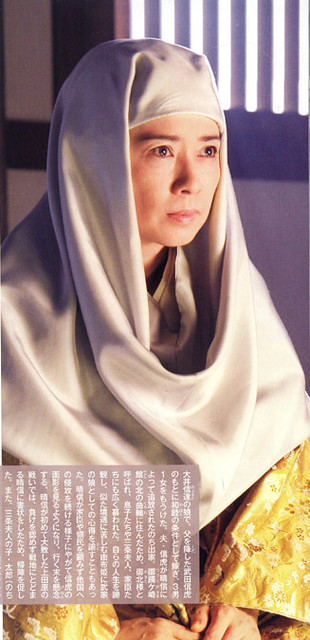
zukin

Sode-zukin example from the NHK taiga drama Fuurin Kazan.

I’m really excited about this last one–I kept wondering why I would sometimes see seam lines on what usually looks like just a rectangular white cloth tied around the head. It’s a kesa! And kesa are usually sewn with what is called the rice-field pattern. And THAT explains the seam lines!
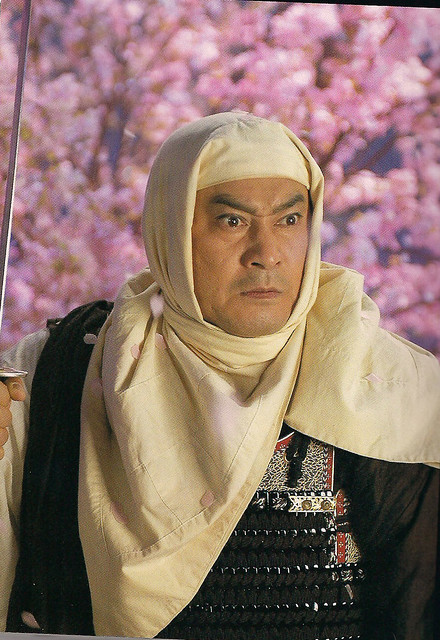
Benkei

From the NHK Drama Yoshitsune, the Warrior Monk Benkei is wearing a Kato no Kesa.

The only thing is I will have to sew like the wind to get the thing done in time and with the pattern, that’s going to be tricky. Plus I still have to write up the information, in a simple format since this is not a literary entry. But I still have almost 3 weeks. I might skip the mousu (which I don’t have as much info about, just an entry from the Japanese Costume Museum) and concentrate on the kato no kesa instead.

Ingibiorg, who also does Japanese poetry here in Calontir, did a poetry exchange with me this summer and asked if she could enter it as an A&S entry for Cattle Raids (an event up in Lincoln, Nebraska where she lives). We each wrote up explanations about our respective poems and how we took elements from each other in the exchange. I think she was going to present the poems on some marbled paper or something? Anyway, no word as to how that turned out. I hope she got some good feedback, since most people tend to ignore poetry entries.
I totally should be sleeping right now

God bless obsessive manga artists who blog about their work and how they are going to draw medieval Buddhist outfits by making little drawings showing how said outfits are put together. Sure, it’s a tertiary source, but given the lack of primary and secondary sources in English (except photos of emaki, paintings, and statues, and some spare descriptions on the Japanese Costume Museum site), I’ll take it. Got a lot of translation to do, though. (PS, I will share the source later once I get some things translated, including the artist/writer’s name, so I can properly credit). (PSS: Won’t be this week, cause Worldcon.) Oh, and those cloth hats the ladies are wearing in The Maple Viewers? So totally zukin. Like I said. *vindication feels like victory*

Chigiri-e

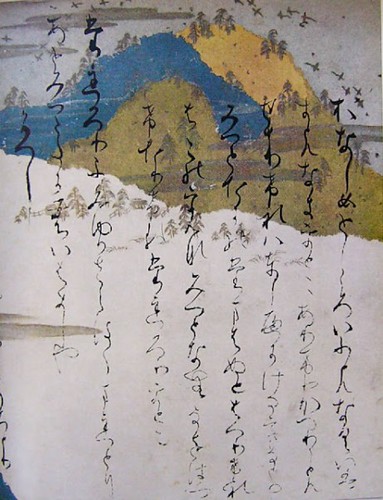
Another answer to a FB question, this time about the process that goes into making the colorful paper that poetry is often written on, like this 10th century example from the collected poems of Lady Ise:

chigiri-e

The paper is dyed (by various methods: sukizome (adding pigments at the time of production), hitashizome (soaking paper in liquid dye), hikizome (applying dyes with wide brushes), and fukizome (spray-dyeing) or marbled (Suminagashi 墨 流 し), then collaged in a technique called chigiri-e (ちぎり絵). It was (and is) hugely expensive–the washi (mulberry paper) has long fibers and is strong enough to withstand that much treatment.

I don’t know the kanji yet for sukizome, hitashizome, hikizome, or fukizome, which came off of the Tokyo museum website in an English description of an exhibit. These are very specific and technical terms, so they aren’t found in general dictionaries and I will have to dig about a bit to see if I can track down the kanji for the words. The paper I’ve gotten from Nihon Shuji tends to only be simply dyed.

To reproduce this kind of paper would be a major project by itself, certainly!

Okiagari koboshi (起き上がり小法師)

In answer to a question on the Calontir list about period (pre-1600) paper mache:

The Japanese have a kind of roly-poly doll that was made via a paper-mache process. They are called Okiagari koboshi (起き上がり小法師) and date to the 14th century. The term means “Little monk that falls down and gets up again.” The famous Daruma dolls are a form of Okiagari koboshi, although they really became popular in the 17th century (post SCA period). Japanese paper (washi) is well-suited for paper mache because it has very long fibers and is strong even when wet. I know they also made masks of paper and lacquer, which were used for theater (like Noh plays) and religious festivals, but I’m not sure of the date on those. Wooden masks are definitely in period–the paper ones I’m not sure about.

Extra for here: while paper was used extensively in Japan very early on, the “traditional Japanese paper crafts” that we often associate with the Japanese (like origami) usually date to the Edo period (1603-1868). The technology was there, but because there was several centuries of internal warfare during the Japanese Middle Ages, there wasn’t much opportunity to devote time and effort to such crafts. However, during the stability of the Edo period, a lot of different paper arts flowered very quickly. The issue for an SCA person is trying to find pre-Edo examples of certain crafts which may or may not have been done before the year 1600.

Rare Japanese Books Course

I’m taking a course on Rare Japanese Books via Futurelearn. It’s a lot more intensive than I had originally thought, but also a LOT of good information. I have a book on Japanese bookbinding that shows how some of this is done, but it was incredibly useful to see videos of these various types of books and how they work.

Tanabata Terror!

Noooo! I was just going to write a little article for the local Shire of Cum an Iolair newsletter about the Tanabata festival. I figured I’d mention a few period celebratory practices, and of course I want to cite where I found them. Problem is…Tanabata was POPULAR. I’ve found mentions in at least 5 diaries, plus it looks like Tale of Genji has something, and I’m betting Eiga Monogatari does also, but of course it doesn’t have a subject index. Found an article on JSTOR arguing that Tanabata came to Japan _before_ the commonly-stated date of 755 AD, based on the number of poems in the Man’yoshu (the last of which is dated 759 AD). And poems! Lots of poems. Man’yoshu, Kokinshu, probably more. Lady Daibu’s diary has an entire chapter of poems devoted to Tanabata (51 poems!) And there’s a Noh play on the subject, too.

This is just supposed to be a little write-up about the festival. I think I’ll keep it simple, but there’s enough here for a decent research paper.

Katsura Tsutsumi 桂包 かつらづつみ

I was answering a question on the SCA Japan FB page and thought I’d record my answer here as well, since I just spent about an hour translating Japanese webpages.

katsura_tsutsume_1

(I found this image on a Google Search. It is from a Japanese photo blog, looks like someone taking pictures at the 2014 Jidai Matsuri parade. The photographer’s handle is EGACITE and his blog is here.)

According to the Costume Museum’s Japanese website, that particular headgear is called katsura tsutsumi 桂包 (かつらづつみ). Katsura is a village, tsutsumi is a long wrapped cloth. According to legend, the women of Katsura began wrapping their heads this way back when the Empress Jingu conquered the three Han states in Korea–the original wrapping was her belt (literally 腹帯 (ふくたい) fukutai = abdominal band, bellybelt, maternity belt, per WWWJDICT translation). It goes on to say that there is no evidence that the legend is true. Here’s a link to a different translation of the page. And yes, as Mistress Saionji says, it’s a long wrapped rectangular cloth. (Side note: Zukin are a different type of headdress–it literally translates to “hood” and was mostly seen on women who had taken Buddhist religious vows of some type.)

Here is a translation I did off of another Japanese page that was defining the term katsura tsutsumi from the Daijirin 3rd Edition: Wrap the head from behind with a long cloth such as a towel, Knot in front, then pull back the remainder on both sides of the face. This was customarily worn by common women of the Muromachi period. “Katsura” [which can mean wig] comes from the village of Katsura.

And a partial rough translation from the Encyclopedia Nipponica: A woman’s headdress from the late middle ages. Wrap the head like a headband in a long white cloth, tied a bit lower in the front. It is also called “Katsura-maki”. From Katsura Village in the Kyoto Western Suburbs. The custom was supposedly begun by fishwives and candy sellers carrying their wares. Legend claims it was bestowed on the women of Katsura by the Empress Jingu, who conquered the Three Han States (in Korea). Pictorial evidence shows this a custom of common women rather than those of the aristocracy, and there are many depictions of common women so attired.

There’s more, but I have to get back to real life. Didn’t realize there would be so much out there on a simple search. Here’s the webpage where I found the above two definitions.