Look, look! Can you see?
A spring-green carpet unfolds
In all directions
Forget the woes of winter
Possibilities await
Link: Our eyes open, our hearts blind to Look, look! Can you see?
Look, look! Can you see?
A spring-green carpet unfolds
In all directions
Forget the woes of winter
Possibilities await
Link: Our eyes open, our hearts blind to Look, look! Can you see?

This very moment when
Yesterday meets tomorrow
Is where we find God
Like fools, we search for heaven
Our eyes open, our hearts blind
Link: Yesterday and tomorrow, with their fingers intertwined to This very moment where yesterday meets tomorrow
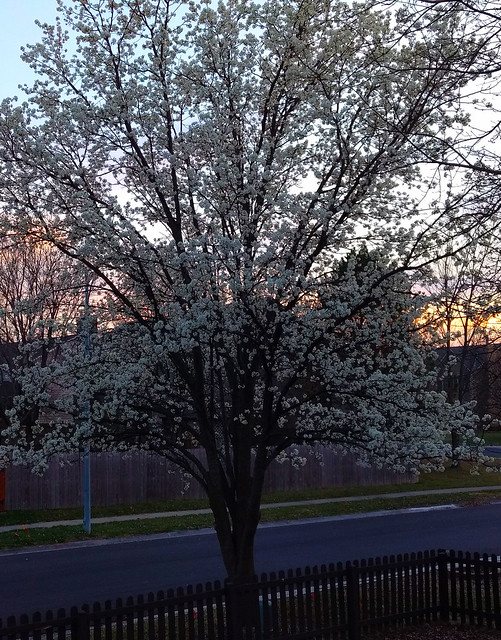
I wonder what you see
There in the misty twilight
Beneath the blossoms?
Yesterday and tomorrow
Airy fingers intertwined
Link: peer/discern to I wonder what you see
Ashen skies open
Let the silver raindrops fall
In pearl-lined puddles
Peer in that make-shift mirror
There my true visage discern
Link: double link “mirror” and “silvering” to “silver,” “pearl-lined,” and “mirror”.
For once in beauty
Shimmering in a mirror
Silvering with age
Shut the curtains, draw the blinds
There is nothing more to see
Link: directly carried For once in beauty to For once in beauty

Blossoming orchard
Humble apple trees preening
For once in beauty
Welcoming soft spring rain like
An innocent girl in love
Link: orchard in blossom to blossoming orchard
I chose apple trees because they are commonly seen in the Midwest and when we lived in Iowa, we lived near an orchard. Kigo 季語 in Japanese poetry are words and phrases associated with seasons. They are often gathered in collections called saijiki 歳時記. However, because the climate where I live in Kansas is far different from that of Japan, I sometimes choose kigo that apply to what I see in my everyday life. The most common flowering trees that were used in medieval tanka were the plum (early spring) and the sakura (middle spring).
Apples actually were not widely cultivated in Japan until the Meiji period (1868-1912), although they are quite popular there now. Here is an interesting list about some Japanese fruits and when they were first cultivated there.
Due to the popularity of the haiku form of poetry, there are some saijiki lists online for English speakers. There is a good one heretranslated by William J. Higginson that focuses on Japanese kigo. There is also an interesting one here called the World Kigo Dictionary that has links to lists for kigo in other parts of the world. However, while they have some for North America, there doesn’t seem to be one specifically for the Midwest. (One for Oklahoma, though, and one for the Northern prairie–but from the descriptions I was reading, that sounds like Minnesota or the Dakotas? Not quite the same thing as here.) There are a number of other lists online as well.
However, while kigo developed out of tanka poetry, some of the traditions were established in the Edo period and are particular to haiku, so if you are writing tanka for SCA (medieval reenactment) purposes, double-check.
Painting by John Everett Millais 1859. (c) Lady Lever Art Gallery; Supplied by The Public Catalogue Foundation
My heart echoes with
Words unspoken, deeds undone,
And a life unlived
A bare-branched tree standing in
An orchard in full blossom
Link: Echoes in the heart to my heart echoes
There seems to be a tree theme creeping in?
Soft misty morning
The mourning dove’s doleful cry
Echoes in my heart
Indistinct, my silent tears
Like dew on bark, unnoticed
Link: Amidst the mist to misty morning
Dew actually does form on bark, but “because the bark and lichen surfaces are porous and hydrophilic, the dew does not form discrete droplets but adds to the water already hydrating the lichen or the surface of the bark.”
New Phytologist, Volume 194, issue 1, p. 10, http://onlinelibrary.wiley.com/doi/10.1111/j.1469-8137.2012.04082.x/pdf
I sleep uneasy
Beneath the blossoming trees
Amidst the mist
In dreams I speak with the dead
In hallow hollowed whispers
Note: link is spring in full blossom to the blossoming trees
Unconsciously, I seem to have echoed the sentiments of Kajii Motojirō (梶井 基次郎) who once famously wrote in his essay Beneath the Cherry Trees:
” Dead bodies are buried beneath the cherry trees!
You have to believe it. Otherwise, you couldn’t possibly explain the beauty of the cherry blossoms. I was restless, lately, because I couldn’t believe in this beauty. But I have now finally understood: dead bodies are buried beneath the cherry trees! You have to believe it. ”
櫻の樹の下には屍體が埋まつてゐる!
これは信じていいことなんだよ。何故つて、櫻の花があんなにも見事に咲くなんて信じられないことぢやないか。俺はあの美しさが信じられないので、この二三日不安だつた。しかしいま、やつとわかるときが來た。櫻の樹の下には屍體が埋まつてゐる。これは信じていいことだ。
The full essay can be read here in a translation by Morgan Giles.
I cannot confess to erudition–I came across the idea in CLAMP’s Tokyo Babylon, which I read some 20 years ago. I was only recently made aware of Kajii’s original material.
I should also note the trees blossoming in my yard are pear, redbud, and crabapple, but there are some cherry trees in a yard down the street. No bodies there (that I know of). The bones would get in the way of the irrigation system.

Spring in full blossom
Branches gently swaying to
The wind’s lively tune
How I want to join the dance
Limping on my crippled feet
Link: “coaxing buds to bloom” to “full blossom”. The theme of pain and longing amidst beauty continues.
 Foxeholly