飾り結び Ornamental Knots

kazari_musubi_examples

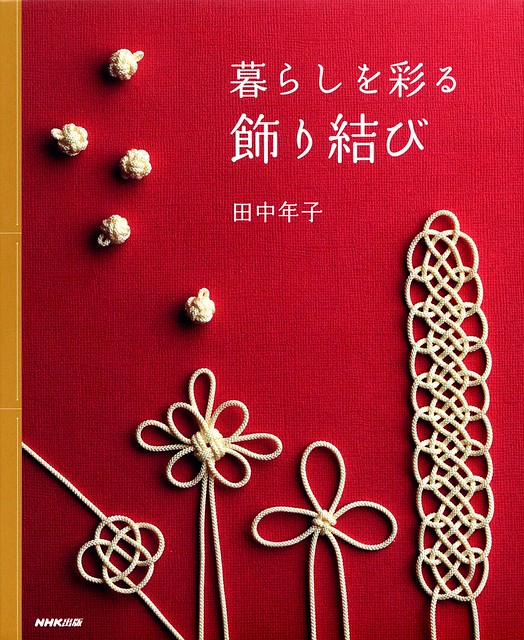
Examples of kazari musubi (ornamental knots) from the cover of the book 暮らしを彩る飾り結び.

A question came up on the SCA Japanese Facebook page regarding kazari musubi 飾り結び (ornamental knots). These were widely used in Japanese clothing and also for decorating and fastening scrolls. The knots were often made of kumihimo cords, so it ends up being a multi-phase process.

While I haven’t found much in English about kazari musubi, there are two excellent books in print available in Japanese:

やさしい飾り結び (Yasashii kazari musubi) “Simple Ornamental Knots” by Hashida Shoen (1983) ISBN 978-4-14-031025-0 .

暮らしを彩る飾り結び (Kurashi o irodoru kazarimusubi) “Decorating with Ornamental Knots” by Tanaka Toshiko (2012) ISBN # 978-4-14-031187-5.

Another way to approach the subject is by looking at Chinese ornamental knots. They are similar but not exactly alike, as they tend to be more complex than the common Japanese designs. Still, the techniques used are the same, and because macrame was such a popular pasttime here in America during the 1970’s, there was a market for books on this subject and so there are several books available in English.

I have found Lydia Chen’s work to be very accessible. She explains the process thoroughly, with a lot of pictures, and has several books out on the subject. Here is a list of her books on Goodreads. I would recommend starting with Chinese Knotting: Creative Designs that are Easy and Fun! and her The Complete Book of Chinese Knotting: A Compendium of Techniques and Variations . The Fashion accessory book is fun but not practical for what we do in the SCA.

There’s a wonderful site called Knotty Notions by Carol Leon-Yun Wang which has some very useful links. Her webpage on Chinese knotting has some instructions for basic knots, too, as well as an excellent bibliography, although maybe not completely up to date at this point.

Of course, this subject ties into kumihimo/kate-uchi, that creates the cords from which these knots are made. I’m just getting my toes wet on this subject, so will report back more as I dig deeper. Still, this is plenty to get a person started and keep them busy for a long time!
Some Useful Links to Get Started with Medieval Japanese Women’s Clothing

sewing_kosode_20181108

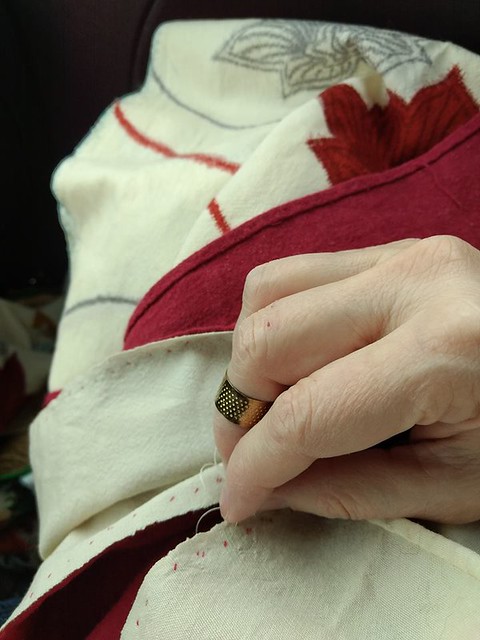
Sewing a Kosode in the car, photo credit Maria Szabo Gilson.

Someone contacted me on Facebook with a question about getting started with Medieval Japanese Women’s Clothing, as he has only researched men’s clothing. Fortunately, women’s clothing was actually simpler than men’s, and there are some excellent websites that can get a person started on the process.

First, I tend to send folks to Saionji no Hana (Lisa Joseph)’s page: The Kosode: a Japanese Garment for SCA Period. I was around when she was first building this page and it was her instructions I used for my first attempts at Japanese garb. She does keep the page updated as she finds more information and is usually happy to answer questions. Note: there are some adjustments that people of size (like myself) have to make with Japanese garb, as the standard ratios do not apply, and she does try to address the issue.

Oribe Tsukime’s Education Page has a lot of well-researched information and copies of her class handouts. She especially enjoys working with dyes. She’s managed to make some amazing garments with some workarounds for those of us who can’t afford real brocade (that would probably be most of us, right?) She’s also very responsive to questions if she run into a problem.

Here is also my humble handout which focuses on the kind of stitches one uses in kosode construction, and links to helpful pages and videos on tricky things like attaching the collar or getting the lining worked out if you chose to line your garment. Kosode Construction: Stitches, Tips, and Tricks.

There are more tutorials to be found on the web, and I encourage people to seek them out. Sometimes the way one person explains things will not work for someone else, so looking through a variety of approaches might be helpful.

Freakin’ Video Games

Someone on the SCA Japanese Facebook page was looking for a way to document Otadzu-no-Kata (Tsubaki-hime), none of which is in Name Construction in Medieval Japan, the go-to documentation source for SCA heralds and Japanese names.

So as I am a herald, I did some digging and found that the client was basing her knowledge from a video game character. That site says the name was an Edo-period creation, a name assigned to the unknown wife of samurai Iio Tsuratatsu, whose sole claim to fame seems to be that he was the son of Iio Noritsura, who was in the service of the Imagawa clan and had possession of Hikuma Castle. Tsuratatsu died in 1565, whereupon his wife took possession of the castle and held it until December of 1568, when Tokugawa Ieyasu attacked.

She was claiming some sources “written in archaic, cursive Japanese” to which I suppose she means Edo-period texts written in kuzushiji, which I fully admit is beyond my own poor skills. However, from digging around, it looks like there are a lot of legends and fictional stories about this woman.

What I did find was a physical shrine, Tsubaki-hime Kannon, whose website gave a brief history.

Okay, best I could get was that her original name was probably Oda Tsuru (Otadzu or Otatsu was a nickname–the O is a honorific, tatsu seems to be another pronunciation of 田鶴, the Japanese love their wordplay.). The Tsubaki-hime part seems to come in play after she and several other women (18 in total) were killed defending Hamamatsu castle (then known as Hikuma castle) from Tokugawa Ieyasu in December of 1568. They were buried in a mound where camilla trees (tsubaki) were planted. So Tsubaki-hime is collective, referring to all the women, not just her. Here’s a link to the webpage of a shrine that was built to honor them by Ieyasu (a replica, the original was long gone.)

Hikuma castle was built by Iio Noritsura, who died in battle in 1560. Otatsu was married to his son, Iio Tsuratatsu, who died in 1565, which was when she took control of the castle. Ieyasu took possession at the end of 1568.

I don’t know if you want the surname Oda, but it’s listed in NCMJ p. 324. Tsuru is NCMJ p. 387. You might be able to argue the おたづ (Otadzu, Otatsu) from the shrine website, which clearly indicates that’s how the name was pronounced. No-kata is also an honorific, so not registrable.

I’ve managed to get some names through without NCMJ by referring to Japanese place websites, so it’s worth a try at least.

No, it’s not perfect. Japan, I love that you are mining your history for video game fodder, but dang, it makes digging online harder!

平成三十年十月二日火曜日

Oh Willow weep and
I shall cry alongside you
Tears intermingling
As the autumn mist rises
At twilight time unbidden

I heard on Tuesday about the suicide of the son of two dear friends of ours from St. Raphael’s in Dubuque. I cannot imagine the pain they are going through. They are the sweetest couple, kind and generous and giving, and to be hit twice this year with such tragedy is beyond belief. (They also lost a grandson this summer.)