Chigiri-e

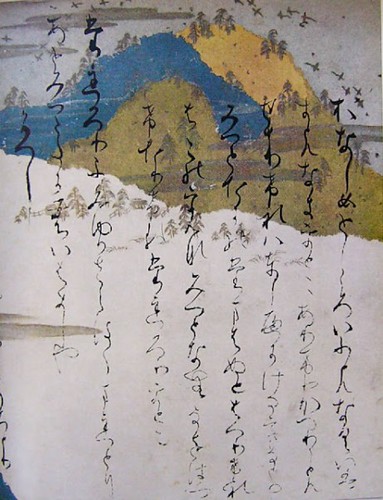
Another answer to a FB question, this time about the process that goes into making the colorful paper that poetry is often written on, like this 10th century example from the collected poems of Lady Ise:

chigiri-e

The paper is dyed (by various methods: sukizome (adding pigments at the time of production), hitashizome (soaking paper in liquid dye), hikizome (applying dyes with wide brushes), and fukizome (spray-dyeing) or marbled (Suminagashi 墨 流 し), then collaged in a technique called chigiri-e (ちぎり絵). It was (and is) hugely expensive–the washi (mulberry paper) has long fibers and is strong enough to withstand that much treatment.

I don’t know the kanji yet for sukizome, hitashizome, hikizome, or fukizome, which came off of the Tokyo museum website in an English description of an exhibit. These are very specific and technical terms, so they aren’t found in general dictionaries and I will have to dig about a bit to see if I can track down the kanji for the words. The paper I’ve gotten from Nihon Shuji tends to only be simply dyed.

To reproduce this kind of paper would be a major project by itself, certainly!

Okiagari koboshi (起き上がり小法師)

In answer to a question on the Calontir list about period (pre-1600) paper mache:

The Japanese have a kind of roly-poly doll that was made via a paper-mache process. They are called Okiagari koboshi (起き上がり小法師) and date to the 14th century. The term means “Little monk that falls down and gets up again.” The famous Daruma dolls are a form of Okiagari koboshi, although they really became popular in the 17th century (post SCA period). Japanese paper (washi) is well-suited for paper mache because it has very long fibers and is strong even when wet. I know they also made masks of paper and lacquer, which were used for theater (like Noh plays) and religious festivals, but I’m not sure of the date on those. Wooden masks are definitely in period–the paper ones I’m not sure about.

Extra for here: while paper was used extensively in Japan very early on, the “traditional Japanese paper crafts” that we often associate with the Japanese (like origami) usually date to the Edo period (1603-1868). The technology was there, but because there was several centuries of internal warfare during the Japanese Middle Ages, there wasn’t much opportunity to devote time and effort to such crafts. However, during the stability of the Edo period, a lot of different paper arts flowered very quickly. The issue for an SCA person is trying to find pre-Edo examples of certain crafts which may or may not have been done before the year 1600.

Rare Japanese Books Course

I’m taking a course on Rare Japanese Books via Futurelearn. It’s a lot more intensive than I had originally thought, but also a LOT of good information. I have a book on Japanese bookbinding that shows how some of this is done, but it was incredibly useful to see videos of these various types of books and how they work.

Tanabata Terror!

Noooo! I was just going to write a little article for the local Shire of Cum an Iolair newsletter about the Tanabata festival. I figured I’d mention a few period celebratory practices, and of course I want to cite where I found them. Problem is…Tanabata was POPULAR. I’ve found mentions in at least 5 diaries, plus it looks like Tale of Genji has something, and I’m betting Eiga Monogatari does also, but of course it doesn’t have a subject index. Found an article on JSTOR arguing that Tanabata came to Japan _before_ the commonly-stated date of 755 AD, based on the number of poems in the Man’yoshu (the last of which is dated 759 AD). And poems! Lots of poems. Man’yoshu, Kokinshu, probably more. Lady Daibu’s diary has an entire chapter of poems devoted to Tanabata (51 poems!) And there’s a Noh play on the subject, too.

This is just supposed to be a little write-up about the festival. I think I’ll keep it simple, but there’s enough here for a decent research paper.

Katsura Tsutsumi 桂包 かつらづつみ

I was answering a question on the SCA Japan FB page and thought I’d record my answer here as well, since I just spent about an hour translating Japanese webpages.

katsura_tsutsume_1

(I found this image on a Google Search. It is from a Japanese photo blog, looks like someone taking pictures at the 2014 Jidai Matsuri parade. The photographer’s handle is EGACITE and his blog is here.)

According to the Costume Museum’s Japanese website, that particular headgear is called katsura tsutsumi 桂包 (かつらづつみ). Katsura is a village, tsutsumi is a long wrapped cloth. According to legend, the women of Katsura began wrapping their heads this way back when the Empress Jingu conquered the three Han states in Korea–the original wrapping was her belt (literally 腹帯 (ふくたい) fukutai = abdominal band, bellybelt, maternity belt, per WWWJDICT translation). It goes on to say that there is no evidence that the legend is true. Here’s a link to a different translation of the page. And yes, as Mistress Saionji says, it’s a long wrapped rectangular cloth. (Side note: Zukin are a different type of headdress–it literally translates to “hood” and was mostly seen on women who had taken Buddhist religious vows of some type.)

Here is a translation I did off of another Japanese page that was defining the term katsura tsutsumi from the Daijirin 3rd Edition: Wrap the head from behind with a long cloth such as a towel, Knot in front, then pull back the remainder on both sides of the face. This was customarily worn by common women of the Muromachi period. “Katsura” [which can mean wig] comes from the village of Katsura.

And a partial rough translation from the Encyclopedia Nipponica: A woman’s headdress from the late middle ages. Wrap the head like a headband in a long white cloth, tied a bit lower in the front. It is also called “Katsura-maki”. From Katsura Village in the Kyoto Western Suburbs. The custom was supposedly begun by fishwives and candy sellers carrying their wares. Legend claims it was bestowed on the women of Katsura by the Empress Jingu, who conquered the Three Han States (in Korea). Pictorial evidence shows this a custom of common women rather than those of the aristocracy, and there are many depictions of common women so attired.

There’s more, but I have to get back to real life. Didn’t realize there would be so much out there on a simple search. Here’s the webpage where I found the above two definitions.

Some Sources on Imayo Songs

Looked this up to answer a question about imayo songs on the SCA:Japanese FB page. Noting here for future reference:

Yung-Hee, Kim Kwon. Songs to Make the Dust Dance: The Ryojin hisho of Twelfth-Century Japan (Berkeley, Univ. of California Press, 1994) ISBN: 9780520080669 Link is to LEGAL electronic copy of full book. (via Lisa Joseph/Mistress Saionji no Hana)

Konishi, Jin’inchi _A History of Japanese Literature, Volume 2: The Early Middle Ages_ (edited by Earl Miner, trans by Nicholas Teele) (Princeton, NJ; Princeton University Press, 1986) ISBN 978-0691101774 has some good discussion on the subject. Konishi had some interest in the subject and devotes a chapter to it. Note–be sure and get the SECOND volume. The first one just has a few lines on imayo, and while the third does has some bits and pieces on it, the 2nd volume is where most of the information is.

Malm, William _Japanese Music and Musical Instruments_ (Tokyo; Tuttle Publishing, 1990) ISBN 978-0804816489 devotes a little time to the subject and is also just good reading about Japanese musical structure anyway, although I suspect he got his imayo info from Konishi’s work? Neither of these works are recent, however.

Miller, Stephen D. _The Wind from Vulture Peak: The Buddhification of Japanese Waka in the Heian Period_ (New York, Cornell East Asia Program, 2013) ISBN 978-1933947662 has some translated imayo and looks some at structure.

I found some cites on a JSTOR search–mostly articles by Yung-Hee Kim Kwon (who wrote _Songs to Make the Dust Dance_ that Lisa Joseph already mentioned), but there were two articles that looked like they might have be of interest to you based on conversations we’ve had in person (this was to the original poster, who lives here in Calontir): Meeks, Lori. 2011. “The Disappearing Medium: Reassessing the Place of miko in the Religious Landscape of Premodern Japan”. History of Religions 50 (3). University of Chicago Press: 208–60. doi:10.1086/656611.

Goodwin, Janet R.. 2000. “Shadows of Transgression: Heian and Kamakura Constructions of Prostitution”. Monumenta Nipponica 55 (3). Sophia University: 327–68.

Online article about a lecture in 2015 by Dr. Elizabeth Markham, who is currently researching imayo Songs of Peace: On Japanese Imayo of the 12th Century.
English-language Tensho Exemplar

My shodo teacher Tony Skeen just published a couple of reference books that will help those looking to make inkan (seals). Both are intended to be used in tandem with the New Nelson’s Japanese-English Character Dictionary.

The first volume is to help people sound-out their (non-Japanese) names in Kanji. There are choices–you can go by meaning, but then the pronunciation will be completely different, or you can go by pronunciation and find comparable kanji–THEN you have to watch for the meaning and also double-check to make sure it doesn’t have some slang meaning in Japanese that might be embarrassing. So this first volume is a list of kanji by sound, in English alpha-order. Choosing Kanji for Use on a Seal Stone

The second volume has brushed tensho-script examples of the kanji from the first volume, both as normal and also in reverse (which is how you would carve it to make a seal). As far as I know, there is no other English-language resource on tensho-script that is this detailed. Tensho Kanji for Making a Seal Stone

Both of these are meant to be used in tandem with the New Nelson’s Japanese/English Character Dictionary. Nelson’s is one of the best J/E Kanji Dictionaries available. Here is the Goodreads link to it. They have it listed new on Amazon for $44 dollars, but seriously, shop around. I found mine new on Ebay for $18, and sometimes you can find it for even less! The New Nelson Japanese-English Character Dictionary. NOTE: Be sure and get the latest version, so the numbers match up. Also, it’s much larger than the original.

I’ve been studying shodo with Tony Skeen for over a year now. He’s a certified instructor through Nihon Shuji Kyoiku Zaidan and has been practicing shodo for over 20 years. The books are pricey, but he’s not making much of a profit–the cost is mainly due to the books being self-published on small print runs.

He let me look at the proofs when he was working on the book and the books are very to-the-point. He just wants to make it easier for people to make better inkan. The online sites that offer to create tensho often use a computer font. These are HAND BRUSHED examples.

GODS of Japan, A to Z Photographic Dictionary

I had seen this page linked on the SCA Japan FB page a while back, but ran across the author in another forum today, so wanted to share the link here as well. Exhaustive list of Japanese statuary, mostly Buddhist with some Shinto. There’s a lot to go through on this site, but very useful AND all in English!

GODS of Japan, A to Z Photographic Dictionary of Japanese Religious Statuary and Art

Poems from Daisougen Nikki 大草原日記 The Great Prairie Diary

Now that Calontir Kingdom Arts and Sciences is over, here is my project. During the year 2015, I challenged myself to compose a tanka poem a day for a year. I didn’t quite hit the mark, but I did write 327 poems. I picked 42 of these poems to present for this project, and wrote documentation for my work. Since I knew most of my judges would probably not have a background in Japanese literature, I tried to give examples of how medieval Japanese poets classified their own poetry. It is a bit of a long read–24 pages, but if you are interested, please enjoy. The format is pdf.

Prairie Poems from the Year Heisei 27

If you have any questions or comments, please let me know!