Final leaf falling
Floating gently to the ground
On a breath of wind
The naked maple shivers
Beneath a pitiless sky
link: blessings fall to leaf falling
Final leaf falling
Floating gently to the ground
On a breath of wind
The naked maple shivers
Beneath a pitiless sky
link: blessings fall to leaf falling
The years pass as the
Year passes, yet your spirit
Still shines like the sun
May blessings fall upon you
Like snow on Mount Yoshino
Link: advent drifts in/the years pass
Written for my friend Saionji no Hana in honor of her birthday
I was so pleased to come across the Waka Poetry site again after several years. It has changed a lot and has a lot to look at!
Doctor Thomas McAuley of the School of East Asian Studies at the University of Sheffield (UK) runs the site. He announced the publication of 3 Japanese poetry e-books today for Kindle. They are:
McAuley, Thomas E. (2016) An Anthology of Classical Japanese Poetry: From Man’yōshū to Shinkokinshū (ASIN: B01MTUKF9K)
McAuley, Thomas E. (2016) Sanekata-shū: The Personal Poetry Collection of Fujiwara no Sanekata (ASIN: B01N47WSOL)
McAuley, Thomas E. (2016) Two Hundred Poem Sequences: The Entō Onhyakushu and Keiun Hyakushu (ASIN: B01N9BKS6A)
I gave them a look-over. Simply and nicely done. VERY reasonable prices compared to what poetry translations usually cost! The Anthology is $8, Sanekata Shu is $3, and Two Hundred-Poem Sequences is $2.99. Considering what Japanese literature books tend to sell for (unless you find them used, and even then! It’s a small market, after all…), these are an incredible bargain!
I was especially excited to see the Two Hundred-Poem Sequences book, since I am researching that topic now, and am trying my hand at a hundred-poem sequence myself.
Candle flame glowing
Yellow leaves quivering as
Autumn shuts her eyes
Advent drifts in on the wind
Wrapped in a cloak iron grey
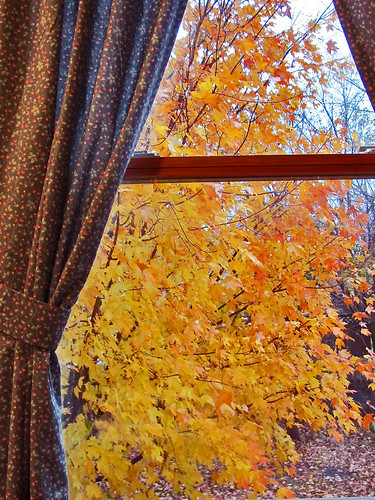
Link: Wet with tears to Autumn shuts her eyes
(Photo by me–the maple tree outside my window.)
A question was asked on the SCA Japanese Facebook page: “Padded Uchigi. Is this just, like, quilted? fluffy? Essentially really thick interfacing? I assume they used silk, but I can’t envision what the final product looks like.”
My answer:
真綿 (mawata) is low-quality silk, nowadays mostly used for making handkerchiefs, but was used for padding on winter garments. This page shows what it looks like: http://www.wildfibres.co.uk/html/mulberry_silk.html
“Was it just stuffed in or how did it stay in place?”
John Marshall actually has a chapter about it in his _Make Your Own Japanese Clothes_, where he discusses the traditional method and then a more modern method better suited towards modern washing using easier to find material (since his book IS about modern clothes). Mawata is sticky, so you basically layer it in place. This webpage shows the process for silk handkerchiefs–it is just on a larger scale for garments. http://www.wormspit.com/mawatas.htm
Marshall, John. Make Your Own Japanese Clothes (Tokyo; Kodansha International, 2013 reprint) 978-1568364933. Originally printed in 1988, ISBN 087011865X.
This is from the SCA Japanese Facebook community–I was answering a question regarding yamabushi and their headwear. The original question was whether yamabushi would wear the same kind of cowl that sōhei wore into battle, and also if anyone could recommend books/sources on the subject of yamabushi.
[A quick definition: yamabushi 山伏 were/are mountain ascetics, usually solitary monks who adhered to Shugendō, esoteric Buddhism which mostly descends from the Shingon sect, but had other influences as well, including Tendai Buddhism, Shinto, and Daoism. Sōhei 僧兵 were warrior monks that were usually attached to a monastery. Yamabushi would sometimes fight, but they were mostly loners and fought in loose confederations, whereas sōhei were groups attached to monasteries.]
The Teeth and Claws of Buddha by Mikael S. Adolphson is the most thorough book I’ve found on the subject of warrior monks. Osprey has done two books on them, one on the Yamabushi and one on the monasteries. Interesting general reading, but start with Adolphson’s book if you want to go deeper into the subject.
What the sōhei wore on their heads was called kato no kesa 裏頭(か[くわ]とう)の袈裟(けさ), and they were kesa (usually worn on the chest) worn on the head–that is technically what kato no kesa means. The yamabushi would sometimes wear kato no kesa, but the headdress more identified with them is the tokin 頭襟, which looks kinda like a small black box. The Japanese Costume museum has it larger and covering the head, but I’ve seen pictures of it being smaller and worn near the forehead, as it is today. Here is a site that has some description of yamabushi clothing. It starts with doctrine, scroll down to see the parts about clothing.
As to whether a tokin would be worn in battle, I am not sure. The emaki depictions that I’ve seen of yamabushi have often just been of them traveling, and they did wear the tokin at those times.
Here’s a picture of a yamabushi from the Japanese Costume museum. Note the hat:

from the Japanese Costume Museum
Now compare to this modern Yamabushi–these are the small tokin I’ve seen in emaki scrolls:
>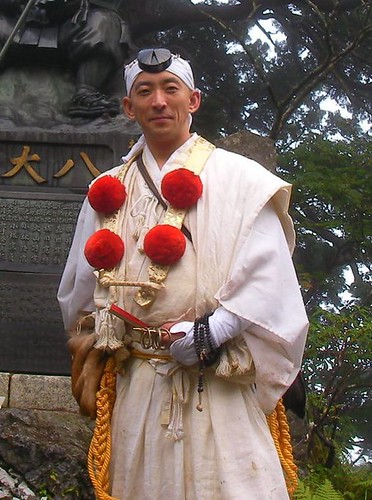
from the now-defunct homepage of Kannonji Temple, Shiga Prefecture. Photographer unknown.
And this is an example of the kato no kesa that sōhei wore:
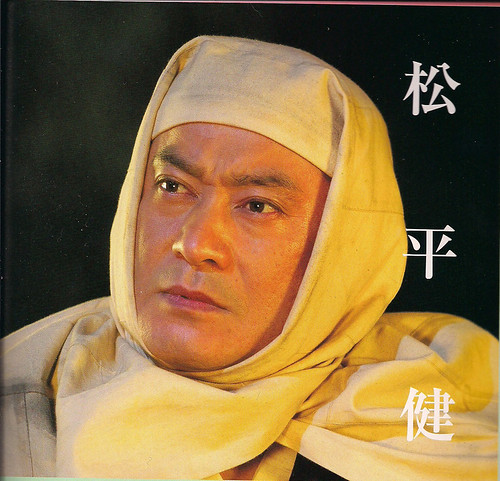
From the Taiga Drama, Yoshitsune, scanned by me.
Update and Correction: when questioned by HE Master Ii Katsumori regarding the modern Yamabushi (who I first identified as a reenactor), I dug deeper to find the origin of the picture, which had been uploaded to Pinterest. The picture is from a now-defunct Japanese webpage (the company hosting it closed, but the Wayback Machine caught it) here: http://homepage3.nifty.com/huayan/temple/event06.htm. I can’t link directly to the Wayback Machine’s page, but that’s the original (defunct) page. Just plug that in the Wayback Machine to see the text (not pictures) of the original.
This used to be the homepage of Kannonji temple. Some more digging showed that the man in the picture is Professor Yoshida Eirie, a professor of Buddhism at Hanazono University in Kyoto and a priest of Kumano Shugendo. Also a martial-arts master of Kukishinden Tenshin Hyoho Ryu. So yes, he IS a modern Yamabushi.
My fingers are bound
And my mouth sewn up with string
My face wet with tears
As our country tears itself
Apart, ripping at the seams
Link: shame to face wet with tears
Written after the election, obviously.
Lit by agony
My words become shuriken
Thrown in a frenzy
In a whirlwind of fury
Behold my harvest of shame
link: agony to agony
Time in suspension
Waiting for the next moment
Excited, afraid
Oh, my breath is stripped away
In exquisite agony
Note: Link is breath of air to breath stripped away. I wrote this while watching the last few minutes of the 2016 World Series with the Chicago Cubs versus the Cleveland Indians. The Cubs won by 1 point during an extra inning AFTER a rain delay, breaking an 108 year record of losses. I’m not a huge Cubs fan or anything, but I did live in the Chicago area for a couple of years when I was little, and have visited there often, so I’m very happy for them.
Kinsukuroi
Knit up with glistening gold
My heart is mended
Yet still so very fragile
Broken with a breath of air
Link: Falling apart at the seams to Knit up with glistening gold. Kinsukuroi 金繕い (also known as kintsugi 金継ぎ) is a process where broken ceramics are mended by using gold as a binder. There is no attempt to hide the fact that the ceramic piece was broken, but instead, the imperfection is recognized and celebrated.
 Foxeholly