Empty sky blinking
Silently she cries, shedding
White frozen teardrops
Falling in all directions
Like a shaken-up snowglobe
link: pitiless sky to empty sky blinking, the falling metaphor also carries over
Empty sky blinking
Silently she cries, shedding
White frozen teardrops
Falling in all directions
Like a shaken-up snowglobe
link: pitiless sky to empty sky blinking, the falling metaphor also carries over
Final leaf falling
Floating gently to the ground
On a breath of wind
The naked maple shivers
Beneath a pitiless sky
link: blessings fall to leaf falling
The years pass as the
Year passes, yet your spirit
Still shines like the sun
May blessings fall upon you
Like snow on Mount Yoshino
Link: advent drifts in/the years pass
Written for my friend Saionji no Hana in honor of her birthday
Candle flame glowing
Yellow leaves quivering as
Autumn shuts her eyes
Advent drifts in on the wind
Wrapped in a cloak iron grey
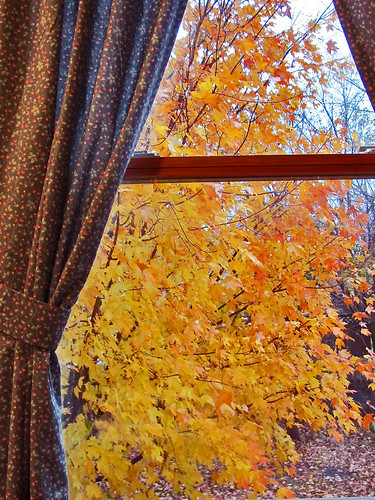
Link: Wet with tears to Autumn shuts her eyes
(Photo by me–the maple tree outside my window.)
My fingers are bound
And my mouth sewn up with string
My face wet with tears
As our country tears itself
Apart, ripping at the seams
Link: shame to face wet with tears
Written after the election, obviously.
Lit by agony
My words become shuriken
Thrown in a frenzy
In a whirlwind of fury
Behold my harvest of shame
link: agony to agony
Time in suspension
Waiting for the next moment
Excited, afraid
Oh, my breath is stripped away
In exquisite agony
Note: Link is breath of air to breath stripped away. I wrote this while watching the last few minutes of the 2016 World Series with the Chicago Cubs versus the Cleveland Indians. The Cubs won by 1 point during an extra inning AFTER a rain delay, breaking an 108 year record of losses. I’m not a huge Cubs fan or anything, but I did live in the Chicago area for a couple of years when I was little, and have visited there often, so I’m very happy for them.
Kinsukuroi
Knit up with glistening gold
My heart is mended
Yet still so very fragile
Broken with a breath of air
Link: Falling apart at the seams to Knit up with glistening gold. Kinsukuroi 金繕い (also known as kintsugi 金継ぎ) is a process where broken ceramics are mended by using gold as a binder. There is no attempt to hide the fact that the ceramic piece was broken, but instead, the imperfection is recognized and celebrated.
Eternity waits
It is unkindly patient
And will not be rushed
But we who are mortal strain
To constrain every minute
A trap, a rope to
Tie me with, I will not lose
My freedom this way
Entice me with your smiles
Enfold me in your warm arms
Arm for a pillow
I gaze at your sleeping face
Noble in repose
Alas, I cannot stay long
The night passes in patches
Passing in patches
The night is stitched up roughly
Like a well-worn quilt
Falling apart at the seams
Barely holding together
Links: 23 “each breath an eternity” to “eternity waits”
24 “Constrain” to “a trap, a rope to tie me with”
25 “enfold me in your warm arms” to “arm for a pillow”
26 “Passing in patches” to “stitched up roughly”
Every night and all
Some cry, some pray, some seek peace
Within another’s arms
Autumn’s widening shadows
Each breath an eternity
Link: Okay, this one is a little obscure: The living and the dead to “every night and all”, which is part of the chorus of the Lyke Wake Dirge.
My favorite version of this ancient song is rather modern, by Andrew Bird and Matt Berniger of The National:
 Foxeholly